March 2, 2026
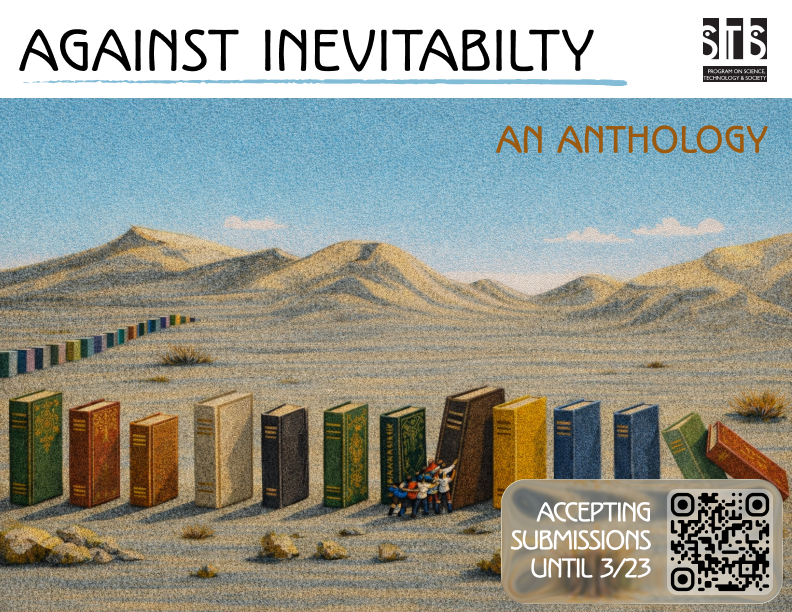
Submissions due here Monday, March 23.
A quarter of the way through the 21st century, we live in an era of the collective shrug. Climate catastrophe, AI-optimized labor markets, and political polarization have begun to remake our worlds in alarming ways, yet we often meet them with resigned acceptance — as inevitable aspects of a world already decided. At the same time, norms and institutions that we once took for granted are rapidly disintegrating. Commitments to international cooperation, public health infrastructures, environmental regulation, and the basic conditions of democratic life now feel fragile in ways that seemed unthinkable just a decade ago. And changes we might actually want to be inevitable — affordable housing, equitable access to education, universal health care, a just energy transition — demand extraordinary effort to advance even an inch.
As students, we see a sense of inevitability up close, at work in our daily lives. Two years ago, using AI on a problem set was suspect. Now, lecture halls across campus are awash with LLMs, and professors increasingly encourage, if not require, their use. Yet, when an entire classroom uses the same chatbot to summarize a reading, or 53% of a graduating class funnels into three industries, the questions on our mind shouldn’t simply concern academic integrity and intellectual vitality. These changes reveal what we have conceded as inevitable — including the ways that digital tools should guide intellectual growth and professional advancement, the kinds of people we should be, and the very futures we deem possible and desirable.
But inevitability, it turns out, is not inevitable. Inevitability is a sociotechnical accomplishment that is produced, sustained, and naturalized through our collective actions. It only becomes a self-fulfilling prophecy when we buy into the idea that people and institutions have no option but to “keep up” with or adapt to technological and political change — what has been called “the great capitulation.” Yet if things have to be made inevitable, how and why does a sense of inevitability take hold? What possibilities are foreclosed when it does?
If we want to resist inevitability on a global scale, we might first understand and challenge how it can take root in our lives at Harvard. This anthology, edited by the Undergraduate Fellows of the Program on Science, Technology and Society, seeks to reanimate a sense of collective agency in the face of felt inevitability. We invite Harvard students, staff, and faculty to interrogate developments that have seemingly taken hold, as well as those that might yet, and to articulate principles that guide what should take hold. Through essays, fiction, poetry, and art, contributors might reflect on questions such as these:
- What developments do you see as inevitable, and what assumptions or values underlie that belief? What would have to change for you to see them as not inevitable?
- Where do you find opportunities to exercise agency, political and personal? What would be involved in bringing about, or resisting, a given trajectory of change? What would be required to build a collective voice, rather than leave individuals to opt out alone?
- How can students see themselves as capable of making the world in new ways, rather than making themselves in the world’s images? What role should faculty and staff play in expanding those possibilities?
- What kinds of citizens should Harvard be training, and by what means? How might Harvard and other elite universities reimagine what it means to be responsible and critical custodians of knowledge and to cultivate forms of engaged citizenship?
Through pieces that grapple with these questions, this anthology seeks to capture a moment in time: how a university community is making sense of the massive forces reshaping its world, and how it might redefine the power to shape that world — and wield it responsibly.
Additional guidelines and information
- Contributors should submit complete pieces. Each piece will go through at least one round of editorial revision after submission.
- Essays and fiction should be between 500 and 2000 words. A contributor can submit one piece of long-form writing and/or up to three pieces of poetry or art.
- Submit pieces through this Google Form.
- The anthology will primarily be distributed in a digital format, though we hope to print several copies as well.