Program on Science, Technology and Society at HarvardHarvard Kennedy School of Government | Harvard University |
|||||||
|
|
STS Circle at Harvard
The STS Circle at Harvard provides a space for weekly conversations about contemporary issues in science and technology that are relevant to fields such as anthropology, history of science, sociology, STS, law, government, public policy, and the natural sciences. Dissertation writers and recent graduates are working on exciting topics that intersect with STS at the edges of their home disciplines. The Circle offers wide exposure to such emerging STS scholarship that otherwise has no forum at Harvard. The STS Circle meets weekly during the academic semester. For Fall 2025, all meetings are planned to take place in person on Mondays, from 12:15-2:00 p.m., in CGIS South S354, 1730 Cambridge Street unless otherwise noted. Sandwich lunches will be provided. To receive the abstract and bio for each talk, and to register to attend, please join our mailing list. The STS Circle at Harvard is co-sponsored by the Graduate School of Arts and Sciences, the Weatherhead Center for International Affairs, and the Harvard University Center for the Environment. 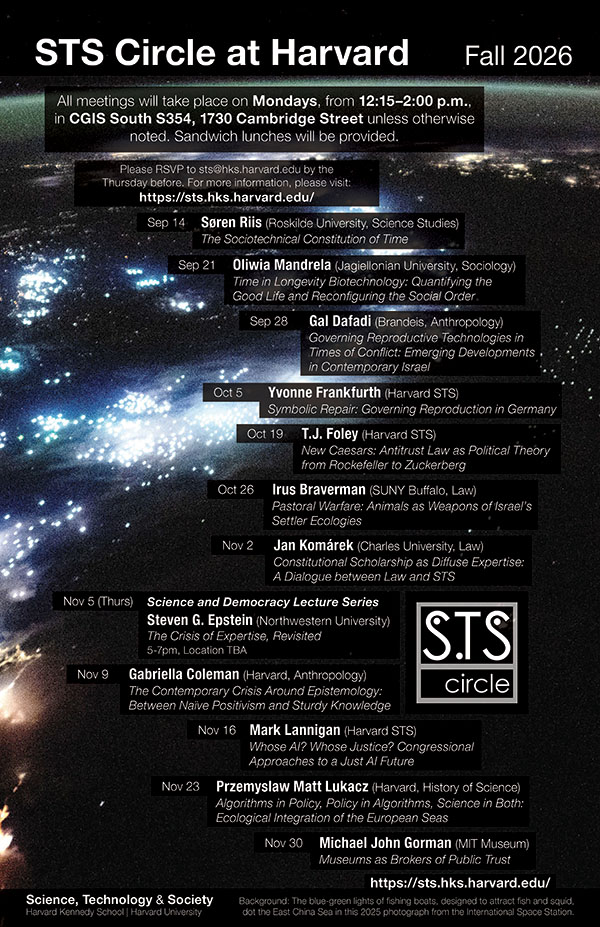 Fall 2026Sep. 14: Søren Riis (Roskilde University, Science Studies)
The Sociotechnical Constitution of Time Sep. 21: Oliwia Mandrela (Jagiellonian University, Sociology)
Time in Longevity Biotechnology: Quantifying the Good Life and Reconfiguring the Social Order Sep. 28: Gal Dafadi (Brandeis, Anthropology)
Governing Reproductive Technologies in Times of Conflict: Emerging Developments in Contemporary Israel Oct. 5: Yvonne Frankfurth (Harvard STS)
Symbolic Repair: Governing Reproduction in Germany Oct. 19: T.J. Foley (Harvard STS)
New Caesars: Antitrust Law as Political Theory from Rockefeller to Zuckerberg Oct. 26: Irus Braverman (SUNY Buffalo, Law)
Pastoral Warfare: Animals as Weapons of Israel's Settler Ecologies Nov. 2: Jan Komárek (Charles University, Law)
Constitutional Scholarship as Diffuse Expertise: A Dialogue between Law and STS Nov. 9: Gabriella Coleman (Harvard, Anthropology)
The Contemporary Crisis Around Epistemology: Between Naïve Positivism and Sturdy Knowledge Nov. 16: Mark Lannigan (Harvard STS)
Whose AI? Whose Justice? Congressional Approaches to a Just AI Future Nov. 23: Przemyslaw Matt Lukacz (Harvard, History of Science)
Algorithms in Policy, Policy in Algorithms, Science in Both: Ecological Integration of the European Seas Nov. 30: Michael John Gorman (MIT Museum) Museums as Brokers of Public Trust 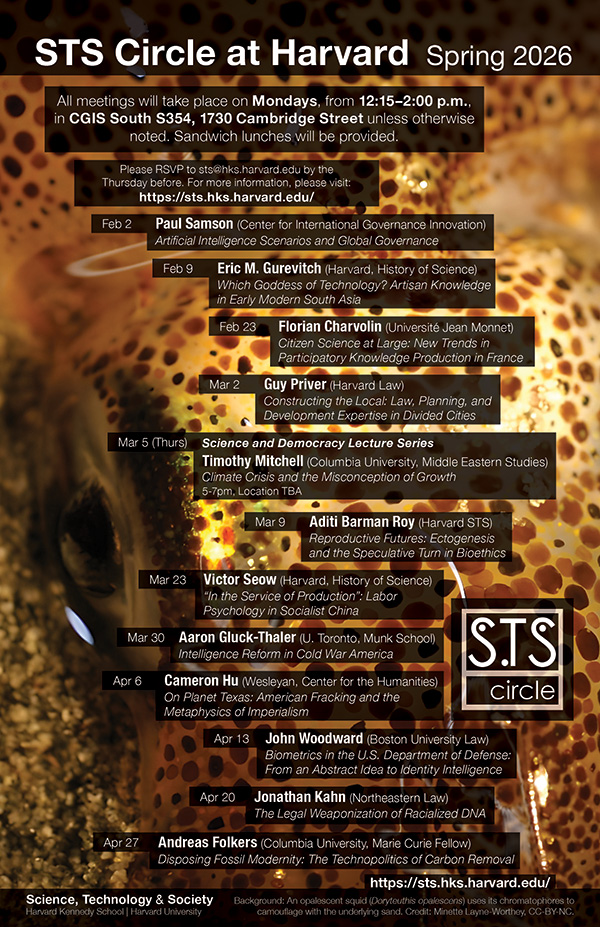 Spring 2026Feb. 2: Paul Samson (Center for International Governance Innovation)
Artificial Intelligence Scenarios and Global Governance Feb. 9: Eric M. Gurevitch (Harvard, History of Science)
Which Goddess of Technology? Artisan Knowledge in Early Modern South Asia Feb. 23: Florian Charvolin (Université Jean Monnet)
Citizen Science at Large: New Trends in Participatory Knowledge Production in France Mar. 2: Guy Priver (Harvard Law)
Constructing the Local: Law, Planning, and Development Expertise in Divided Cities Mar. 9: Aditi Barman Roy (Harvard STS)
Reproductive Futures: Ectogenesis and the Speculative Turn in Bioethics Mar. 23: Victor Seow (Harvard, History of Science)
"In the Service of Production": Labor Psychology in Socialist China Mar. 30: Aaron Gluck-Thaler (U. Toronto, Munk School)
Intelligence Reform in Cold War America Apr. 6: Cameron Hu (Wesleyan, Center for the Humanities)
On Planet Texas: American Fracking and the Metaphysics of Imperialism Apr. 13: John Woodward (Boston University Law)
Biometrics in the U.S. Department of Defense: From an Abstract Idea to Identity Intelligence Apr. 20: Jonathan Kahn (Northeastern Law)
The Legal Weaponization of Racialized DNA Apr. 27: Andreas Folkers (Columbia University, Marie Curie Fellow) Disposing Fossil Modernity: The Technopolitics of Carbon Removal 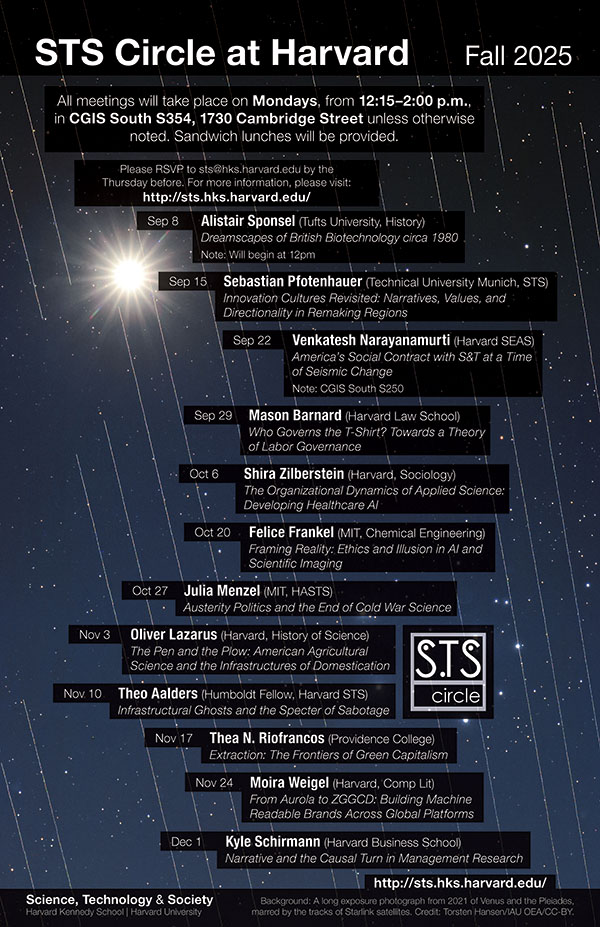 Fall 2025Sep. 8: Alistair Sponsel (Tufts University, History)
Dreamscapes of British Biotechnology circa 1980 Note: Will begin at 12pm Sep. 15: Sebastian Pfotenhauer (Technical University Munich, STS)
Innovation Cultures Revisited: Narratives, Values, and Directionality in Remaking Regions Sep. 22: Venkatesh Narayanamurti (Harvard SEAS)
America's Social Contract with S&T at a Time of Seismic Change Note: CGIS South S250 Sep. 29: Mason Barnard (Harvard Law School)
Who Governs the T-Shirt? Towards a Theory of Labor Governance Oct. 6: Shira Zilberstein (Harvard, Sociology)
The Organizational Dynamics of Applied Science: Developing Healthcare AI Oct. 20: Felice Frankel (MIT, Chemical Engineering)
Framing Reality: Ethics and Illusion in AI and Scientific Imaging Oct. 27: Julia Menzel (University of Toronto Institute for the History and Philosophy of Science and Technology)
Austerity Politics and the End of Cold War Science Nov. 3: Oliver Lazarus (Harvard, History of Science)
The Pen and the Plow: American Agricultural Science and the Infrastructures of Domestication Nov. 10: Theo Aalders (Humboldt Fellow, Harvard STS)
Infrastructural Ghosts and the Specter of Sabotage Nov. 17: Thea N. Riofrancos (Providence College)
Extraction: The Frontiers of Green Capitalism Nov. 24: Moira Weigel (Harvard, Comp Lit)
From Aurola to ZGGCD: Building Machine Readable Brands Across Global Platforms Dec. 1: Kyle Schirmann (Harvard Business School) Narrative and the Causal Turn in Management Research 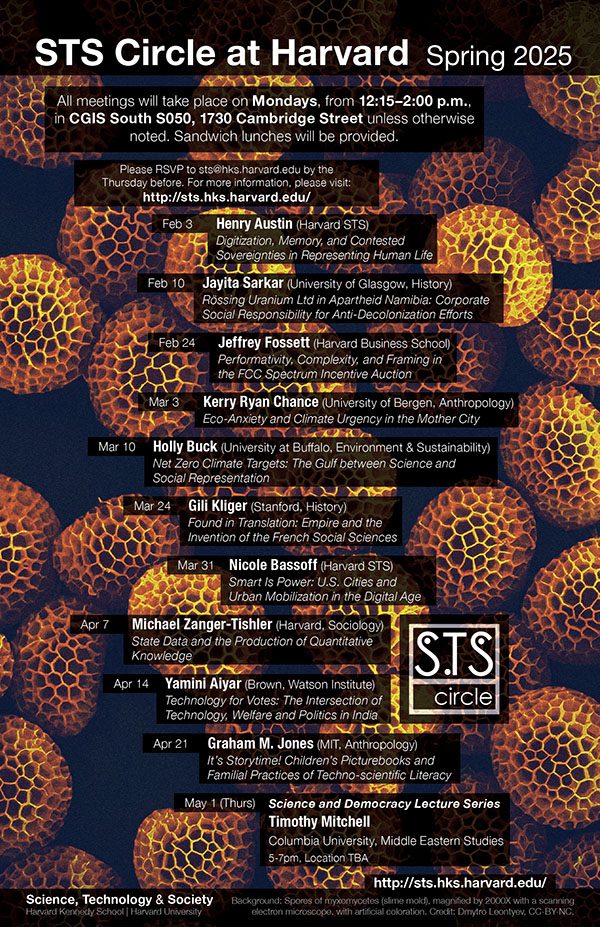 Spring 2025Feb. 3: Henry Austin (Harvard Kennedy School, Global Observatory on Genome Editing)
Feb. 10: Jayita Sarkar (University of Glasgow, History)
Rössing Uranium Limited in Apartheid Namibia: Corporate Social Responsibility for Anti-Decolonization Efforts Feb. 24: Jeffrey Fossett (Harvard Business School)
Performativity, Complexity, and Framing in the FCC Spectrum Incentive Auction Mar. 3: Kerry Ryan Chance (University of Bergen, Norway, Anthropology)
Eco-Anxiety and Climate Urgency in the Mother City Mar. 10: Holly Buck (University at Buffalo, Environment & Sustainability; 2024-2025 Harvard Radcliffe-Salata Climate Justice Fellow)
Net Zero Climate Targets: The Gulf between Science and Social Representation Mar. 24: Gili Kliger (Stanford University, History)
Found in Translation: Empire and the Invention of the French Social Sciences Mar. 31: Nicole Bassoff (Harvard Kennedy School)
Smart is Power: U.S. Cities and Urban Mobilization in the Digital Age Apr. 7: Michael Zanger-Tishler (Harvard University, Sociology & Social Policy)
State Data and the Production of Quantitative Knowledge Apr. 14: Yamini Aiyar (Brown University, Watson Institute)
Technology for Votes: The Intersection of Technology, Welfare and Politics in India Apr. 21: Graham Jones (MIT, Anthropology) It's Storytime! Children’s Picturebooks and Familial Practices of Techno-scientific Literacy 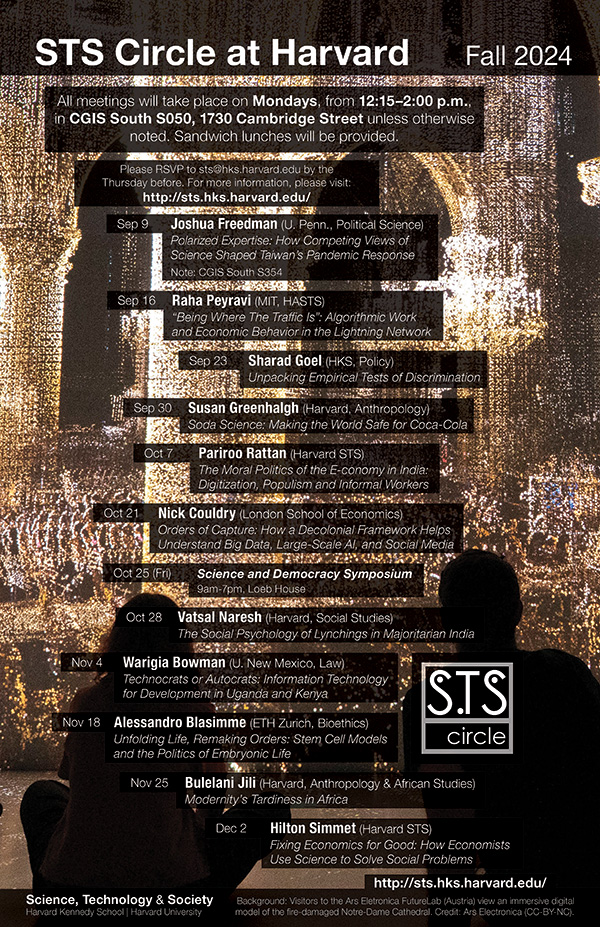 Fall 2024Sep. 9: Joshua Freedman (U. Penn., Political Science)
Polarized Expertise: How Competing Views of Science Shaped Taiwan's Pandemic Response Note: CGIS South S354 Sep. 16: Raha Peyravi (MIT, HASTS)
"Being Where The Traffic Is": Algorithmic Work and Economic Behavior in the Lightning Network Sep. 23: Sharad Goel (HKS, Policy)
Unpacking Empirical Tests of Discrimination Sep. 30: Susan Greenhalgh (Harvard, Anthropology)
Soda Science: Making the World Safe for Coca-Cola Oct. 7: Pariroo Rattan (Harvard STS)
The Moral Politics of the E-conomy in India: Digitization, Populism and Informal Workers Oct. 21: Nick Couldry (London School of Economics)
Orders of Capture: How a Decolonial Framework Helps Understand Big Data, Large-Scale AI, and Social Media Oct. 28: Vatsal Naresh (Harvard, Social Studies)
The Social Psychology of Lynchings in Majoritarian India Nov. 4: Warigia Bowman (U. New Mexico, Law)
Technocrats or Autocrats: Information Technology for Development in Uganda and Kenya Nov. 18: Alessandro Blasimme (ETH Zurich, Bioethics)
Unfolding Life, Remaking Orders: Stem Cell Models and the Politics of Embryonic Life Nov. 25: Bulelani Jili (Harvard, Anthropology & African Studies)
Modernity's Tardiness in Africa Dec. 2: Hilton Simmet (Harvard STS) Fixing Economics for Good: How Economists Use Science to Solve Social Problems 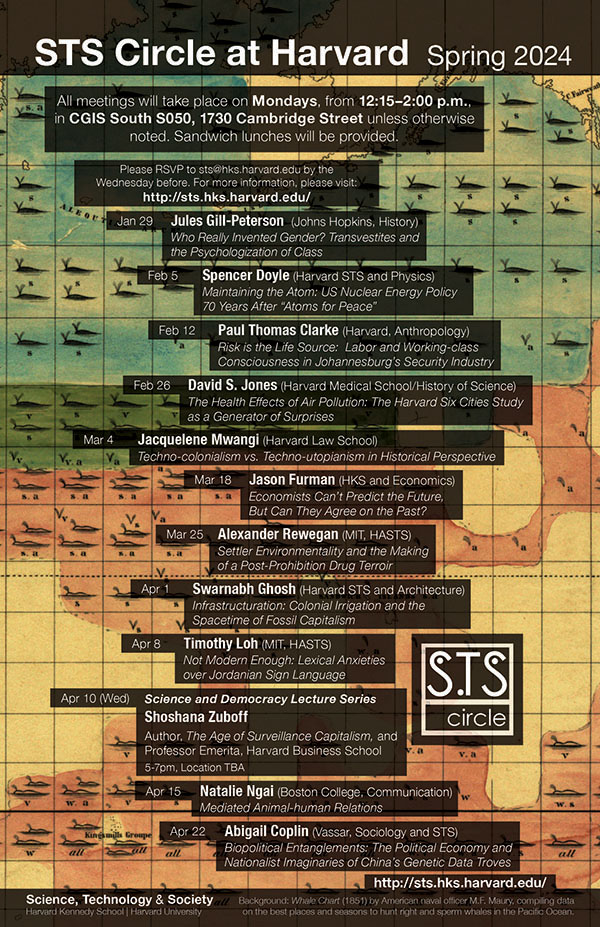 Spring 2024Jan. 29: Jules Gill-Peterson (Johns Hopkins, History)
Who Really Invented Gender? Transvestites and the Psychologization of Class Feb. 5: Spencer Doyle (Harvard STS and Physics)
Maintaining the Atom: US Nuclear Energy Policy 70 Years After “Atoms for Peace” Feb. 12: Paul Thomas Clarke (Harvard, Anthropology)
Risk is the Life Source: Labor and Working-class Consciousness in Johannesburg’s Security Industry Feb. 26: David S. Jones (Harvard Medical School/History of Science)
The Health Effects of Air Pollution: The Harvard Six Cities Study as a Generator of Surprises Mar. 4: Jacquelene Mwangi (Harvard Law School)
Techno-colonialism vs. Techno-utopianism in Historical Perspective Mar. 18: Jason Furman (HKS and Economics)
Economists Can’t Predict the Future, But Can They Agree on the Past? Mar. 25: Alexander Rewegan (MIT, HASTS)
Settler Environmentality and the Making of a Post-Prohibition Drug Terroir Apr. 1: Swarnabh Ghosh (Harvard STS and Architecture)
Infrastructuration: Colonial Irrigation and the Spacetime of Fossil Capitalism Apr. 8: Timothy Loh (MIT, HASTS)
Not Modern Enough: Lexical Anxieties over Jordanian Sign Language Apr. 15: Natalie Ngai (Boston College, Communication)
Mediated Animal-human Relations Apr. 22: Abigail Coplin (Vassar, Sociology and STS) Biopolitical Entanglements: The Political Economy and Nationalist Imaginaries of China’s Genetic Data Troves  Fall 2023Sep. 11: Kate Brown (HASTS, MIT)
Big Brother and the Nuclear Security State®: MADE IN AMERICA Sep. 18: Maddy Kroot (Geography, Clark University)
Decarbonization vs. Democratization? Participatory Politics and the New England Grid Sep. 25: Austin Clyde (Computer Science, University of Chicago)
The Prompt Engineer's Paradox: The Hidden Human Effort in AI Systems Oct. 2: Sannoy Das (Harvard Law School)
Instruments of the Rich: Subsidies and the Idea of the International Economy Oct. 16: Lucía Ortiz de Zárate Alcarazo (Universidad Autónoma de Madrid)
Framing Artificial Intelligence in Spain, Chile, and Mexico Oct. 23: Iris Hilbrich (Sociology, University of Hamburg)
Geoengineering the Climate: Sociotechnical Transformations and Changing Knowledge Practices in the Anthropocene Oct. 30: Anna Thieser (Columbia, Sociology)
Open Network of the Saints: Closure and Translation in the Maintenance of Ethereum Nov. 6: Adam Longenbach (Harvard GSD)
Hate Architecture: Combat Towns and the Construction of the Enemy Nov. 13: Michèle Lamont (Sociology, Harvard)
The Sociology of Valuation and Evaluation (SVE): From Peer Review to Concepts of Worth Nov. 20: Sushant Kumar (Public Policy, Northeastern)
From Population to People: Deconstructing the Population Control Debate in India Nov. 27: Andrew Stokols (Urban Studies & Planning, MIT) Building Digital Cities and Digital Nations in the Age of Big Data  Spring 2023Jan. 30: Jamie Wong (HASTS, MIT)
Crowdsourced Cats: Machine Learning as Culture in Chinese Governance Feb. 6: Sam Weiss Evans (Harvard STS & Harvard SEAS)
Governance of Security Concerns in Science Feb. 13: Rahul Bhatia (Harvard Radcliffe Institute)
India’s Biometric Identity Project LOCATION CHANGE: Bell Hall, Belfer Building, Harvard Kennedy School, 79 JFK St Feb. 27: Marlise Schneider (Technical University Munich & Harvard STS)
Ever Upward? Microchip Futures for New York’s Rustbelt Mar. 6: Arunabh Ghosh (History, Harvard)
China and Global Small Hydropower in the 1980s Mar. 20: Abigail Coplin (Vassar)
The Precarious Expert: Science and the State During China’s GMO Controversy Mar. 27: Martin Abbott (S&TS, Cornell)
Fragile New Orleans. Fortress New Orleans Apr. 3: Andy Murray (Harvard STS)
Democracy in a Dish? Open Insulin and the Democratization of Biotechnology Apr. 10: Elizabeth Dietz (ASU & Harvard STS)
No Choice But to Choose: Informed Consent, Abortion, and the Politics of Denying Politics Apr. 17: Larry Au (City College of New York)
Chinese Scientists and Imaginaries of Global Science Apr. 24: Neil Safier (Brown) Translating the Plantationocene from the Prevolutionary Caribbean to Colonial Brazil  Fall 2022Sep. 12: Brenda Dvoskin (Harvard Law School)
Expert Governance of Online Speech Sep. 19: Archon Fung (Harvard Kennedy School)
Epistemic Polarization: Who Killed the Truth and Can We Resurrect It? Sep. 26: Edward R. Carr (Clark University, International Development, Community, and Environment)
Transformational Adaptation as an Applied STS Problem Oct. 3: Sam Bookman (Harvard Law School)
What We Talk About When We Talk About “Environmental Constitutionalism” Oct. 17: Aniket De (Harvard University, History)
Racial Segregation and Colonial Self-Government: South Africa and British India, 1900–35 Oct. 24: Lundy Braun (Brown University, Pathology and Laboratory Medicine)
Algorithms, Race, and Racism: Historical Perspectives Oct. 31: Anthony Acciavatti (Yale University, Architecture)
Sensing Village Life: Satellites, Lies, and Videotape in India Nov. 7: Pierre Delvenne (University of Liège, Political Science)
Moving Cells, Making Value: The Biography of Living Things Revisited Nov. 14: Tawanna Dillahunt (University of Michigan, Information)
Alternative Narratives of Digital Futures: A Discussion of Equitable Approaches Nov. 21: José Perillan (Vassar College, Physics and STS)
Science Between Myth and History: Writing the Past to Control the Future Nov. 28: Karl Dudman (Harvard STS) Cooperative Extension, Climate Science, and the Quest for the Public Good  Spring 2022Jan. 31: Michelle Spektor (MIT HASTS)
Quantifying the 'National Physique': Deterioration, Degeneracy, and the Proposed British National Anthropometric Survey of 1904 Feb. 7: Madisson Whitman (Center for Science & Society, Columbia)
As Close to Robot as Possible: The Making of Data Subjects in Higher Education Feb. 14: Tiffany Nichols (History of Science, Harvard)
Expanding the Astrophysics Laboratory: Environment, Ecosystem, and Experiment Feb. 28: Jason Jackson (DUSP, MITl)
Moral Orders of Capitalist Legitimacy In India Mar. 7: Laura Diaz Anadon (Centre for Environment, Energy and Natural Resource Governance, Cambridge University)
Technology Spillovers in the Energy Transition Mar. 21: Michaela Thompson (HUCE, Harvard)
Speaking (for) Sharks: Contested Expertise in Marine Conversation Mar. 28: Louis Hyman (ILR School, Cornell)
Migrant Labor and the Origin of Silicon Valley Apr. 4: Mary Gray (Microsoft Research, NE)
The Trouble with Dogfood: Towards a Theory of Mutuality in Computing Apr. 11: Gordon Hanson (Harvard Kennedy School)
Spatial Economic Analysis Apr. 18: Nicole Sintetos (Brown, Harvard STS)
Bureaucratizing Settler Colonialism: Race, Labor, and the Origins of the Bureau of Reclamation Apr. 25: Ya-Wen Lei (Sociology, Harvard) Upgrading the Nation: Promise and Peril of Techno-Developmentalism in China  Fall 2021Sep. 13: Eric Beerbohm (Government, Harvard)
How to Gaslight Citizens Sep. 20: Jack Hensley (SEAS, Harvard)
Geoengineering the Climate with a Human-made Volcano Sep. 27: Marion Boulicault (Philosophy, MIT)
Gender, Time, and the Measurement of Fertility Oct. 4: Mathias Risse (Harvard Kennedy School)
The Truth Will Not Set You Free: Is There a Right to It Anyway? Oct. 18: Gabriel Dorthe (IASS Potsdam & Harvard STS)
Sociotechnical Promises and Their By-products Oct. 25: Abby Spinak (Harvard GSD)
Electricity and Empowerment: Towards a More Critical Energy History Nov. 1: Onur Ozgode (Harvard STS)
Fractals of Governance: The Management of Systemic Risk at the Limits of Liberalism, 1913–2010 Nov. 8: Anna Lvovsky (Harvard Law)
Vice Patrol: Antigay Policing and the Politics of Knowledge before Stonewall Nov. 15: Elettra Bietti (Harvard Law)
A Genealogy of Digital Platform Regulation Nov. 22: Lily Hu (Applied Math and Philosophy, Harvard)
Categories and Causation in the Social Sciences Nov. 29: Alex Wellerstein (STS, Stevens Institute of Technology) How to Lose a Lot of Weapons-Grade Uranium and Get Away with It  Spring 2021Feb. 1: Dwai Banerjee (STS, MIT)
The Global Politics of Emergency Vaccines: A Primer on Decolonizing the Pandemic Feb. 8: Makoto Takahashi (MCTS, TU Munich)
The Improvised Expert: Performing Authority in Fukushima Feb. 22: Deborah Coen (History of Science, Yale)
What's the Use of Climate Science? Towards a History of the Usable Turn Mar. 8: Jessica Lynn Dickson (AAAS, Harvard)
Extracting Ghosts: 'Hollywood' World-building through Sites of Ruination in South Africa Mar. 15: Colleen Lanier Christensen (History of Science, Harvard)
Chemical Harmonies: The Politics of Standardized Practices and Controls Mar. 22: Roxana Vatanparast (STS, Harvard)
"Of Nations Linked Together": Cables, the League of Nations & the Construction of Imagined Global Communities Mar. 29: Jeannette Estruth (History, Bard)
Worker Coalitions in the Reagan-Era Silicon Valley Apr. 5: Lisa Messeri (Anthropology, Yale)
Technological Terroir: Tracing the Cultivation of "Tech" in Los Angeles Apr. 12: Marc F. Aidinoff (HASTS, MIT)
Digital Welfare Reform: The Constitutional Project of Computerizing Government Apr. 19: Elena Sobrino (HASTS, MIT)
Economy's Nature: Interrogating Green Chemistry from the Rust Belt Apr. 26: Ed Hackett (Sociology, Brandeis) Sociological Ambivalence Revisited 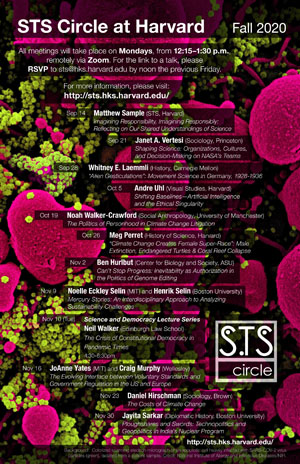 Fall 2020Sep. 14: Matthew Sample (STS, Harvard)
Imagining Responsibility, Imagining Responsibly: Reflecting on Our Shared Understandings of Science Sep. 21: Janet A. Vertesi (Sociology, Princeton)
Shaping Science: Organizations, Cultures, and Decision-Making on NASA's Teams Sep. 28: Whitney E. Laemmli (History, Carnegie Mellon)
"Alien Gesticulations": Movement Science in Germany, 1928-1936 Oct. 5: Andre Uhl (Visual Studies, Harvard)
Shifting Baselines—Artificial Intelligence and the Ethical Singularity Oct. 19: Noah Walker-Crawford (Social Anthropology, University of Manchester)
The Politics of Personhood in Climate Change Litigation Oct. 26: Meg Perret (History of Science, Harvard)
"Climate Change Creates Female Super-Race": Male Extinction, Endangered Turtles & Coral Reef Collapse Nov. 2: Ben Hurlbut (Center for Biology and Society, ASU)
Can't Stop Progress: Inevitability as Authorization in the Politics of Genome Editing Nov. 9: Noelle Eckley Selin (MIT) and Henrik Selin (Boston University)
Mercury Stories: An Interdisciplinary Approach to Analyzing Sustainability Challenges Nov. 16: JoAnne Yates (MIT) and Craig Murphy (Wellesley)
Where Standards and Regulations Meet: Referring to Standards in US and European Regulation Since 1945 Nov. 23: Daniel Hirschman (Sociology, Brown)
The Costs of Climate Change Nov. 30: Jayita Sarkar (Diplomatic History, Boston University) Ploughshares and Swords: Technopolitics and Geopolitics in India's Nuclear Program 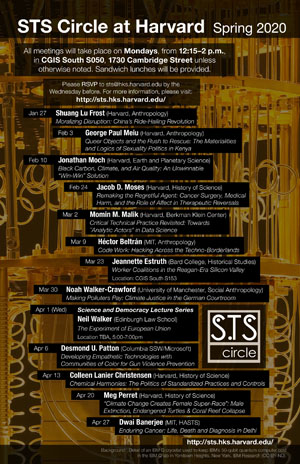 Spring 2020Jan. 27: Shuang Lu Frost (Harvard, Anthropology)
Moralizing Disruption: China's Ride-Hailing Revolution Feb. 3: George Paul Meiu (Harvard, Anthropology)
Queer Objects and the Rush to Rescue: The Other Side of Sexuality Politics in Kenya Feb. 10: Jonathan Moch (Harvard, Earth and Planetary Sciences)
Black Carbon, Climate, and Air Quality: An Unwinnable 'Win-Win' Solution Feb. 24: Jacob D. Moses (Harvard, History of Science)
Remaking the Regretful Agent: Cancer Surgery, Medical Harm, and the Role of Affect in Therapeutic Reversals Mar. 2: Momin M. Malik (Harvard, Berkman Klein Center)
Critical Technical Practice Revisited: Towards ``Analytic Actors Mar. 9: Héctor Beltrán (MIT, Anthropology)
(Remaining meetings for Spring 2020 were cancelled because of the COVID-19 pandemic.)Code Work: Hacking Across the Techno-Borderlands 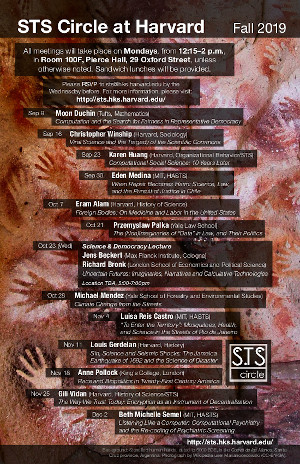 Fall 2019Sep. 9: Moon Duchin (Tufts, Mathematics)
Computation and the Search for Fairness in Representative Democracy Sep. 16: Christopher Winship (Harvard, Sociology)
Viral Science and the Tragedy of the Scientific Commons Sep. 23: Karen Huang (Harvard, Organizational Behavior/Harvard STS)
Computational Social Science: 10 Years Later Sep. 30: Eden Medina (MIT, HASTS)
When Repair Becomes Harm: Science, Law, and the Pursuit of Justice in Chile Oct. 7: Eram Alam (Harvard, History of Science)
Foreign Bodies: On Medicine and Labor in the United States Oct. 21: Przemyslaw Palka (Yale Law School)
The (Non)Imaginaries of “Data” in Law, and their Politics Note: CGIS S250 Oct. 28: Michael Mendez (Yale School of Forestry and Environmental Studies)
Climate Change from the Streets Nov. 4: Luisa Reis Castro (MIT, HASTS)
“To Enter the Territory”: Mosquitoes, Health, and Science in the streets of Rio de Janeiro Nov. 11: Louis Gerdelan (Harvard, History)
Sin, Science and Seismic Shocks: The Jamaica Earthquake of 1692 and the Science of Disaster Nov. 18: Anne Pollock (King’s College, London)
Race and Biopolitics in 21st-Century America Note: CGIS S250 Nov. 25: Gili Vidan (Harvard, History of Science/Harvard STS)
The Way We Trust Today: Encryption as an Instrument of Decentralization Note: CGIS S250 Dec. 2: Beth Michelle Semel (MIT, HASTS) Listening Like a Computer: Computational Psychiatry and the Re-coding of Psychiatric Screening 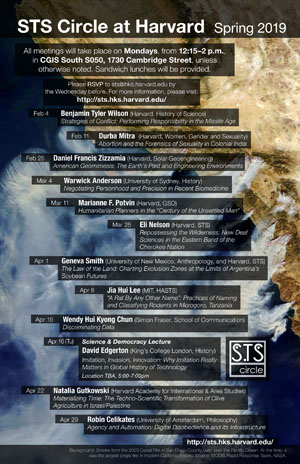 Spring 2019Feb. 4: Benjamin Tyler Wilson (Harvard, History of Science)
Strategies of Conflict: Performing Responsibility in the Missile Age Feb. 11: Durba Mitra (Harvard, Women, Gender and Sexuality)
Abortion and the Forensics of Sexuality in Colonial India Feb. 25: Daniel Francis Zizzamia (Harvard, Solar Geoengineering)
American Geomimesis: The Earth's Past and Engineering Environments Mar. 4: Warwick Anderson (University of Sydney, History)
Negotiating Personhood and Precision in Recent Biomedicine Mar. 11: Marianne F. Potvin (Harvard, GSD)
Humanitarian Planners in the "Century of the Unsettled Man" Mar. 25: Eli Nelson (Williams College, Anthropology)
Repossessing the Wilderness: New Deal Sciences in the Eastern Band of the Cherokee Nation Apr. 1: Geneva Smith (University of New Mexico, Anthropology, and Harvard, STS)
The Law of the Land: Charting Exclusion Zones at the Limits of Argentina's Soybean Futures Apr. 8: Jia Hui Lee (MIT, HASTS)
"A Rat By Any Other Name": Practices of Naming and Classifying Rodents in Morogoro, Tanzania Apr. 15: Wendy Hui Kyong Chun (Simon Fraser University, School of Communication)
Discriminating Data Apr. 22: Natalia Gutkowski (Harvard Academy for International and Area Studies)
Materializing Time: The Techno-Scientific Transformation of Olive Agriculture in Israel/Palestine Apr. 29: Robin Celikates (University of Amsterdam, Philosophy) Agency and Automation: Digital Disobedience and Its Infrastructure 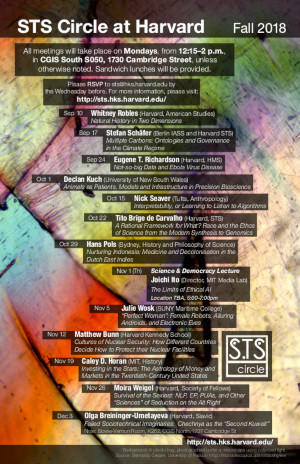 Fall 2018Sep. 10: Whitney Robles (Harvard, American Studies)
Natural History in Two Dimensions Sep. 17: Stefan Schäfer (Potsdam IASS and Harvard STS)
Multiple Carbons: Ontologies and Governance in the Climate Regime Sep. 24: Eugene T. Richardson (Harvard, HMS)
Not-so-big Data and Ebola Virus Disease Oct. 1: Declan Kuch (University of New South Wales, Environmental Humanities)
Animals as Patients, Models and Infrastructure in Precision Bioscience Oct. 15: Nick Seaver (Tufts, Anthropology)
Interpretability, or Learning to Listen to Algorithms Oct. 22: Tito Brige de Carvalho (Harvard, STS)
A Rational Framework for What? Race and the Ethos of Science from the Modern Synthesis to Genomics Oct. 29: Hans Pols (Sydney, History and Philosophy of Science)
Nurturing Indonesia: Medicine and Decolonisation in the Dutch East Indies Nov. 5: Julie Wosk (SUNY Maritime College)
“Perfect Woman”: Female Robots, Alluring Androids, and Electronic Eves Nov. 12: Matthew Bunn (Harvard Kennedy School)
Cultures of Nuclear Security: How Different Countries Decide How to Protect their Nuclear Facilities Nov. 19: Caley D. Horan (MIT, History)
Investing in the Stars: The Astrology of Money and Markets in the Twentieth-Century United States Nov. 26: Moira Weigel (Harvard, Society of Fellows)
Survival of the Sexiest: NLP, EP, PUAs, and Other “Sciences” of Seduction on the Alt Right Dec. 3: Olga Breininger-Umetayeva (Harvard, Slavic) Failed Sociotechnical Imaginaries: Chechnya as the “Second Kuwait” Note: Bowie-Vernon Room, K262, CGIS North, 1737 Cambridge St 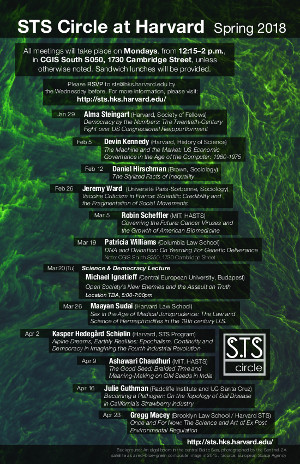 Spring 2018Jan. 29: Alma Steingart (Harvard, Society of Fellows)
Democracy by the Numbers: The Twentieth-Century Fight over US Congressional Reapportionment Feb. 5: Devin Kennedy (Harvard, History of Science)
The Machine and the Market: US Financial Governance in the Age of the Computer: 1960-1975 Feb. 12: Daniel Hirschman (Brown, Sociology)
The Stylized Facts of Inequality Feb. 26: Jeremy Ward (Université Paris-Sorbonne, Sociology)
Vaccine Criticism in France: Scientific Credibility and the Fragmentation of Social Movements Mar. 5: Robin Scheffler (MIT, HASTS)
Governing the Future: Cancer Viruses and the Growth of American Biomedicine Mar. 19: Patricia Williams (Columbia Law School))
DNA and Divination: On Yearning For Genetic Deliverance Note: CGIS South S250, 1730 Cambridge Street Mar. 26: Maayan Sudai (Harvard Law School)
Sex in the Age of Medical Jurisprudence: The Law and Science of Hermaphrodites in the 19th century U.S. Apr. 2: Kasper Hedegård Schiølin (Harvard, STS Program)
Alpine Dreams, Earthly Realities: Epochalism, Continuity and Democracy in Imagining the Fourth Industrial Revolution Apr. 9: Ashawari Chaudhuri (MIT, HASTS)
The Good Seed: Braided Time and Meaning-Making on GM Seeds in India Apr. 16: Julie Guthman (Radcliffe Institute and UC Santa Cruz)
Becoming a Pathogen: On the Topology of Soil Disease in California’s Strawberry Industry Apr. 23: Gregg Macey (Brooklyn Law School/Harvard STS) Once and For Now: The Science and Art of Ex Post Environmental Regulation 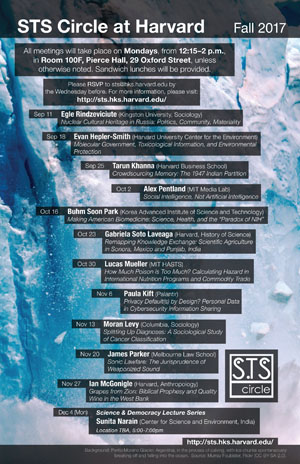 Fall 2017Sep. 11: Egle Rindzeviciute (Kingston University, Sociology)
Nuclear Cultural Heritage in Russia: Politics, Community, Materiality Sep. 18: Evan Hepler-Smith (Harvard University Center for the Environment)
Molecular Government, Toxicological Information, and Environmental Protection Sep. 25: Tarun Khanna (Harvard Business School)
Crowdsourcing Memory: The 1947 Indian Partition Oct. 2: Alex Pentland (MIT Media Lab)
Social Intelligence, Not Artificial Intelligence Oct. 16: Buhm Soon Park (Korea Advanced Institute of Science and Technology)
Making American Biomedicine: Science, Health, and the 'Paradox of NIH' Oct. 23: Gabriela Soto Laveaga (Harvard, History of Science)
(Dis)Locating Science: Scientific Agriculture in 1960s Mexico and India Oct. 30: Lucas Mueller (MIT HASTS)
Cancerous Environments and the Global Search for Cancer’s Causes Nov. 6: Paula Kift (Palantir)
Privacy Default(s) by Design? Personal Data in Cybersecurity Information Sharing Nov. 13: Moran Levy (Columbia, Sociology)
Splitting Up Diagnoses: A Sociological Study of Cancer Classification Nov. 20: James Parker (Melbourne Law School)
Sonic Lawfare: The Jurisprudence of Weaponized Sound Nov. 27: Ian McGonigle (Harvard, Anthropology) Grapes from Zion: Biblical Prophesy and Quality Wine in the West Bank 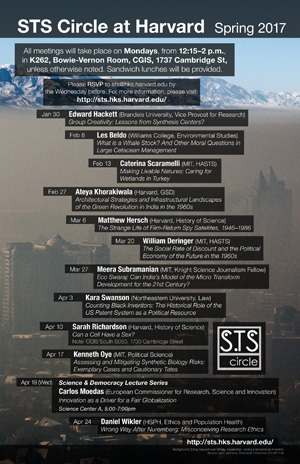 Spring 2017Jan. 30: Edward Hackett (Brandeis University, Vice Provost for Research)
Collaboration and Creativity: Lessons from Synthesis Centers (and Elsewhere) Feb. 6: Les Beldo (Williams College, Environmental Studies)
What is a Whale Stock? And Other Moral Questions in Large Cetacean Management Feb. 13: Caterina Scaramelli (MIT, HASTS)
Making Livable Natures: Caring for Wetlands in Turkey Feb. 27: Ateya Khorakiwala (Harvard, GSD)
Architectural Strategies and Infrastructural Landscapes of the Green Revolution in India in the 1960s Mar. 6: Matthew Hersch (Harvard, History of Science)
In-House to Outhouse: The Strange Life of Film-Return Spy Satellites, 1946–1986 Mar. 20: William Deringer (MIT, HASTS)
The Social Rate of Discount and the Political Economy of the Future in the 1960s Mar. 27: Meera Subramanian (MIT, Knight Science Journalism Fellow)
Eco Swaraj: Can India’s Model of the Micro Transform Development for the 21st Century? Apr. 3: Kara Swanson (Northeastern University, Law)
Counting Black Inventors: The Historical Role of the US Patent System as a Political Resource Apr. 10: Sarah Richardson (Harvard, History of Science)
Can a Cell Have a Sex? Note: CGIS South S050, 1730 Cambridge Street Apr. 17: Kenneth Oye (MIT, Political Science)
Assessing and Mitigating Synthetic Biology Risks: Exemplary Cases and Cautionary Tales Apr. 24: Daniel Wikler (HSPH, Ethics and Population Health) Wrong Way After Nuremberg: Misconceiving Research Ethics  Fall 2016Sep. 12: Elise K. Burton (Middle Eastern Studies & History)
Accidents of Geography: Creating Genetic Cartographies of the Middle East Sep. 19: Jeremy Baskin (University of Melbourne, Political Science)
The Competing Imaginaries of Solar Geoengineering Sep. 26: Phil Brown (Northeastern University, University Distinguished Professor of Sociology and Health Sciences)
Post-Belmont Research Ethics: Reporting Personal Exposure Data to Participants Oct. 3: Christopher Lawrence (Harvard, STS)
Normalization by Other Means: The Failed Techno-Diplomacy of Light Water Reactor Export to North Korea Oct. 17: Rachel Douglas-Jones (IT University of Copenhagen, Denmark)
Governance by Committee: Stem Cell Research Oversight and Deliberation in the USA Oct. 24: Scott Frickel (Brown, Sociology)
'Three Scientists Walk into a Barricade…' Expert mobilization in Two Boston-area Social Movements Oct. 31: Sunil Amrith (Harvard, History)
Coastal South Asia and the Technologies of Risk Nov. 7: Laura Martin (Harvard, HUCE)
Radiation and Restoration: The Politics of Ecological Care Nov. 14: Bettina Stoetzer (MIT, Global Studies and Languages) Ruderal Ecologies: Re-Thinking Urban Infrastructure in a World of Rubble Nov. 21: Gökçe Gunel (Columbia University, Anthropology)
Spaceship in the Desert: Energy, Climate Change and Urban Design in Abu Dhabi Nov. 28: Jay D. Aronson (Carnegie Mellon, History) The Promise and Peril of Human Rights Technology  Spring 2016Feb. 1: Jill Lepore (Harvard, History)
The Past As Proof Feb. 8: Larissa Belcic (Harvard, GSD)
Playlist from the Terrestrial Analog: Towards an Ecology of Outer Space Feb. 22: Lisa Haushofer (Harvard, History of Science/Chemical Heritage Foundation)
“Pepsin Era” – Artificially Digested Foods and the Eating Body Feb. 29: Behnam Taebi (Harvard, HKS Belfer Center)
Responsible Innovation and Public Values in the Dutch Shale Gas Controversy Mar. 7: Shreeharsh Kelkar (MIT, HASTS)
Platformizing Higher Education: Computer Science and the Making of MOOC Infrastructures Mar. 21: Aziza Ahmed (Northeastern Law School)
Risk, Feminism, and AIDS Mar. 28: Yael Berda (Hebrew University, Sociology and Anthropology)
The File and the Checkpoint: Managing Citizenship in Israel and India after Independence Apr. 4: Alden Young (Drexel University, History and Africana Studies)
Sudanese Economics: Between an Environmental and a Political Imagination Apr. 11: Cara Kiernan Fallon (Harvard, History of Science)
Healthy Forever? Aging, Mobility, and the Transformation of Later Life Apr. 18: Arunabh Ghosh (Harvard, WCFIA)) No ‘Mean’ Solution: The Reformulation of Statistical Science in the Early People’s Republic of China Apr. 20: Yaron Ezrahi (Hebrew University), Andy Stirling (University of Sussex), & Shiv Visvanathan (Jindal Global University) With Comment From: Jane Mansbridge (HKS)
Science and Democracy Lecture:The Elusive Demos: Democracy in the Digital Age Note: Will be held 5-7PM in Location TBA Apr. 25: Trevor Pinch (Cornell S&TS) Stanley Milgram and the Sonic Imaginary  Fall 2015Sep. 8: Andreas Mitzschke (Maastricht University, STS)
Competing, Conflicting, and Contested Futures: Temporal Imaginaries in the GM Crops Controversy Note: Will be held in CGIS, K262 Sep. 14: Megan Black (Harvard, Warren Center)
Rethinking Landsat: The American State and Big Oil in the Space Race Sep. 21: Thorsten Trimpop (MIT, Comparative Media Studies)
Meanwhile in Japan — Filming in the Nuclear Exclusion Zone Note: Will be held in Milstein East A, 2036 Wasserstein Hall, Harvard Law School, 1585 Massachusetts Avenue Sep. 28: David A. Mindell (MIT, STS)
Our Robots, Ourselves: Robotics and the Myths of Autonomy Oct. 5: Michael Aaron Dennis (U.S. Naval War College)
Memex takes Manhattan: Vannevar Bush's other History of the Future Oct. 19: Myles Jackson (NYU-Gallatin)
The Genealogy of a Gene: Patents, HIV/AIDS and Race Oct. 26: Susanne E. Freidberg (Dartmouth, Geography)
Obstinate Harvest: Corporate Food and the Technoscience of Supply Chain Sustainability Nov. 2: Andrew Jewett (Harvard, History)
Of Science and Scientism: Framing Science in the Postwar American Humanities Nov. 4: William Nordhaus (Yale University)
Science and Democracy Lecture: Climate Clubs: The Central Role of the Social Sciences in Climate Change Policy Note: Will be held 5-7PM in Science Center A Nov. 9: Joseph Rouse (Wesleyan, Philosophy)
What is a Scientific Conception of the World? Nov. 16: Saptarishi Bandopadhyay (Harvard Law School)
What We Talk About when We Talk About Disasters: Early Modern Precedents for 21st-Century Disaster Management Nov. 23: Stu Marvel (Emory University)
The 'Nature' of Queer Families: Tracking the Socio-Technics of the Fertility Clinic Co-sponsored with Women and Gender Studies (FAS) Nov. 30: John P. McCaskey (Columbia University) Universal Laws and the Case of Cholera  Spring 2015Feb. 2: Tom Özden-Schilling (MIT, HASTS)
Expertise in Exile: Indigenous GIS and the Precariousness of Professionalization Feb. 9: Arunabh Ghosh (Harvard, Weatherhead Center)
CANCELLED: No 'Mean' Solution: The Reformulation of Statistical Science in the Early People's Republic of China Feb. 23: Michael Bennett (University of Michigan, Risk Science Center)
The Ascent of Science Fictional Futurity in Anglo-American Legal Thought Mar. 2: Steve Caton (Harvard, Anthropology)
Experts in Cruelty: Interrogation in Abu Ghraib and After Mar. 9: Geert Somsen (Columbia/Maastricht, History)
'Science and World Order': Uses of Science in Plans for International Government, 1899-1950 Mar. 23: Dan Navon (Harvard, Robert Wood Johnson Fellow)
Mobilizing Mutations: New Kinds of People at the Intersection of Genetics and Patient Advocacy Mar. 30: Margo Boenig-Liptsin (Harvard, STS/History of Science)
A New Literacy for the Information Age: Children, Computers, and Citizenship Apr. 6: Anna M. Agathangelou (York University, Political Science)
Emerging Legal and Forensic BioConstitutional Order(s) in Post-Conflict Cyprus Apr. 13: Emily Harrison (Harvard, History of Science)
Infant Science and Health Adventuring: Global Intervention around Infant Mortality Apr. 20: Rajesh Veeraraghavan (UC Berkeley/Harvard Berkman Center)
The Politics of Openness: Technology, Corruption and Participation in Indian Public Employment Apr. 27: Antoine Picon (Harvard, GSD) Cities, Technologies and Political Imaginaries  Fall 2014Sep. 8: Aaron Mauck (Harvard, History of Science)
Social Molecules: Biomarkers and the New Data Imaginary in Social Science Research Sep. 15: David Lazer (Northeastern, Political Science, )
Computational Social Science: The Use of 'Big Data' to Study Human Behavior The event will meet in Pound Hall 200 at the Harvard Law School Sep. 22: Angie Boyce (Harvard, Robert Wood Johnson Fellow)
Chicken, Egg, or Cook? Foodborne Salmonellosis and Distributed Responsibility Sep. 29: Benjamin Morris (MIT, Catalyst Collaborative)
Science/Fiction: Dramatic Arts as a Medium for Translating Science Oct. 6: Scott Podolsky (Harvard Medical School/Massachusetts General Hospital) Antimicrobials and Public Health: From Serotherapy to Antibiotics (and Back) Oct. 20: Venkatesh Narayanamurti (Harvard, SEAS)
Bridging the Basic-Applied Dichotomy and the Cycle of Discovery and Invention Oct. 27: Zoe Nyssa (Harvard, HUCE/STS Fellow)
Ecologies of Paradox: A Typology of Scientific Surprise in the Anthropocene Nov. 3: Richard Rottenburg (University of Halle, Anthropology)
Emerging “Global Health” Institutions in Africa: Technologies and Significations Nov. 10: Naor Ben-Yehoyada (Harvard, Center for Middle Eastern Studies)
'I can feel the mafia but I can’t see it': An Anthropology of Forensic Knowledge Nov. 17: Heather Paxson (MIT, Anthropology)
Regulating Microbial Ecologies: Policy and Practice in Artisanal Cheesemaking Nov. 24: Canay Özden-Schilling (MIT, HASTS)
Economics Inside the Grid: Smart Grids, Power Systems Engineering, and Emergent Markets Dec. 1: Zara Mirmalek (Harvard, STS Fellow) Democracy and the Deep-Sea: Telepresence and Public Participation in Remote Environments  Spring 2014Feb. 3: David Engerman (Brandeis, History)
The Import of Expertise: Towards an International History of Indian Economic Planning Feb. 10: Rachel Rothschild (Yale, History of Science)
Modeling without 'Target' Maps: Scientific Cooperation on Atmospheric Pollution in the Cold War Feb. 24: Jana Cephas (Harvard, GSD)
'The Body is Like an Automobile Chassis': Visualizing Control at the Henry Ford Hospital Mar. 3: David Meshoulam (University of Wisconsin, Madison)
Science Education Across Mass Ave: PSSC and the History of (Harvard) Project Physics, 1961-1970 Mar. 10: Victor Seow (Cornell, History)
Carbon Technocracy: East Asian Energy Regimes and the Industrial Modern Mar. 24: Alberto Cambrosio (McGill, Social Studies of Medicine)
When drugs cross disease lines. (Dis)assembling clinical research in post-genomic oncology. Mar. 31: Rochelle Sharpe (Freelance Journalist)
Sex, Lies and Technology: A Journalist's Encounters with Bioethics and Big Data Apr. 7: Sherine Hamdy and Soha Bayoumi (Brown, Anthropology, and Harvard, History of Science)
'Doctors of the Revolution': Egypt's Political Uprisings and the Limits of Medical Neutrality Apr. 14: Joakim Juhl (Harvard, STS-SEAS)
Innovation Science in the Making: Theoretical Physics and Industrial Production in a Danish Factory Apr. 21: Susan Greenhalgh (Harvard, Anthropology)
Obesity, Inc.?: Fat Science and Policy in the People's Republic of China Apr. 28: Joyce Chaplin (Harvard, History) Early Modern Climate Science: The View from British North America  Fall 2013Sep. 9: Bridget Hanna (Harvard, Anthropology)
The Anthropologist and the Conspiracy Theory: Suspicion and Research after Bhopal Sep. 16: Daniel Kevles (Yale, History)
A, B, Seeds: Advertising, Branding, and IP in an Emergent Industry Sep. 23: Shobita Parthasarathy (University of Michigan, Ford School)
Making Democracy in the Patent System: Comparing the Life Form Patent Battles in the US and Europe Sep. 30: Alvaro Santana-Acuña (Harvard, Sociology)
The Three Sides of a Nation-State: Cadastral Triangulation and the Making of Modern France Oct. 7: Adam Bly (Seed Media Group)
A New Narrative for Science in America Oct. 21: Yanni Loukissas (Harvard, Berkman Center)
Data Narratives of the Arnold Arboretum Oct. 28: David Keith (Harvard, SEAS)
What we can learn from the failure of climate policy Nov. 4: James Bergman (Harvard, History of Science)
Working on Climatic Time: Climatology and Labor Practices in Postwar Industrial Agriculture Nov. 11: Sherry Turkle (MIT, STS)
The Dystopian Presented as the Utopian: Does the Internet lead us to forget what we know about life? Nov. 18: Nate Towery (MIT, STS)
(Not) Getting from Us to We: Expertise as a roadblock to change in U.S. environmental organizations Nov. 25: Andrew Barry (University College London, Human Geography)
Interrogating the Anthropocene Dec. 2: S.M. Amadae (University of Ohio, Political Science) Imagining the Neoliberal Subject: Nuclear Deterrence and the Prisoner's Dilemma  Spring 2013Feb. 4: Elizabeth Lunbeck (Vanderbilt/Harvard, History of Science)
Horrible Bosses: Analyzing Workplace Dysfunction Feb. 12: Jean Comaroff (Harvard, African and African American Studies/Anthropology)
Divine Detection: Crime and the Metaphysics of Disorder Date and Location Change: Tuesday, HUCE Seminar Room, 24 Oxford Street Feb. 25: Hanna Rose Shell (MIT/STS)
SPEAKER CANCELLATION: Shoddy Heap: Textile Waste Processing and Alien Flora Mar. 4: Ryan Shapiro (MIT/HASTS)
'A Vote Against Beagles is a Vote Against Apple Pie': The Pentagon Poison Gas Experiments, 1973-1975 Mar. 11: Charles Rosenberg (Harvard, History of Science)
The Tyranny of Diagnosis: Disease in History and History in Disease Mar. 25: Lukas Rieppel (Northwestern,STS)
Assembling the Dinosaur: Money, Museums, and American Culture, 1870-1930 Apr. 1: Brice Laurent (Ecole des Mines, Paris and Harvard, STS)
A Common European Space? Harmonizing the Sustainability of European Biofuels Apr. 8: Stephanie Dick (Harvard, History of Science)
Coded Collaboration: Doing Mathematics with Computers in the Second Half of the Twentieth Century Apr. 15: Henry Turner (Rutgers, Radcliffe Institute)
Corporations in the Scientific and Political Life of Early Modern England Apr. 22: Henry Cowles (Princeton, History)
Vocabularies of Method: Pragmatism and the History of Science Apr. 29: Kaushik Sunder Rajan (Chicago, Anthropology) Courting Innovation: The Constitution(s) of Indian Biomedicine 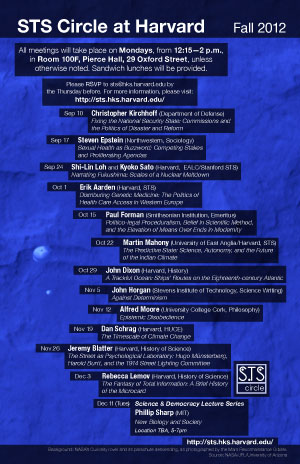 Fall 2012Sep. 10: Christopher Kirchhoff (Department of Defense)
Fixing the National Security State: Commissions and the Politics of Disaster and Reform Sep. 17: Steven Epstein (Northwestern, Sociology)
Sexual Health as Buzzword: Competing Stakes and Proliferating Agendas Sep. 24: Shi-Lin Loh and Kyoko Sato (Harvard, EALC/Stanford STS)
Narrating Fukushima: Scales of a Nuclear Meltdown Oct. 1: Erik Aarden (Harvard, STS)
Distributing Genetic Medicine: The Politics of Health Care Access in Western Europe Oct. 15: Paul Forman (Smithsonian Institution, Emeritus)
Politico-legal Proceduralism, Belief in Scientific Method, and the Elevation of Means Over Ends in Modernity Oct. 22: Martin Mahony (University of East Anglia/Harvard STS)
The Predictive State: Science, Autonomy, and the Future of the Indian Climate Nov. 5: John Horgan (Stevens Institute of Technology, Science Writing)
Against Bio-Determinism Nov. 12: Alfred Moore (University College Cork, Philosophy)
Epistemic Disobedience Nov. 19: Dan Schrag (Harvard, HUCE)
The Timescale of Climate Change Nov. 26: Jeremy Blatter (Harvard, History of Science)
The Street as Psychological Laboratory: Hugo Münsterberg, Harold Burtt, and the 1914 Street Lighting Committee Dec. 3: Rebecca Lemov (Harvard, History of Science)
The Fantasy of Total Information: A Brief History of the Microcard Dec. 10: John Dixon (Harvard, History) A Trackful Ocean: Ships' Routes on the Eighteenth-century Atlantic 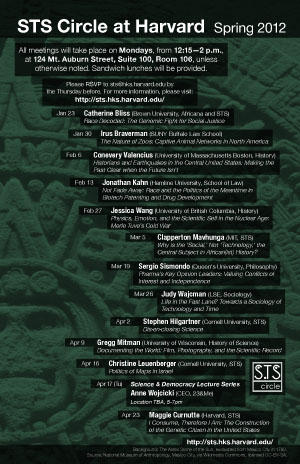 Spring 2012Jan. 23: Catherine Bliss (Brown University, Africana and STS)
Race Decoded: The Genomic Fight for Social Justice Jan. 30: Irus Braverman (SUNY Buffalo Law School)
The Nature of Zoos: Captive Animal Networks in North America Feb. 6: Conevery Valencius (University of Massachusetts Boston, History)
Historians and Earthquakes in the Central United States: Making the Past Clear when the Future Isn't Feb. 13: Jonathan Kahn (Hamline University, School of Law)
Not Fade Away: Race and the Politics of the Meantime in Biotech Patenting and Drug Development Feb. 27: Jessica Wang (University of British Columbia, History)
Physics, Emotion, and the Scientific Self in the Nuclear Age: Merle Tuve's Cold War Mar. 5: Clapperton Mavhunga (MIT, STS)
Why is the 'Social,' Not 'Technology,' the Central Subject in African(ist) History? Mar. 19: Sergio Sismondo (Queen’s University, Philosophy)
Pharma's Key Opinion Leaders: Valuing Conflicts of Interest and Independence Mar. 26: Judy Wajcman (LSE, Sociology)
Life in the Fast Lane? Towards a Sociology of Technology and Time Apr. 2: Stephen Hilgartner (Cornell University, STS)
Dis·en·closing Science Apr. 9: Gregg Mitman (University of Wisconsin, History of Science)
Documenting the World: Film, Photography, and the Scientific Record Apr. 16: Christine Leuenberger (Cornell University, STS)
Politics of Maps in Israel Apr. 23: Maggie Curnutte (Harvard, STS) I Consume, Therefore I Am: The Construction of the Genetic Citizen in the United States 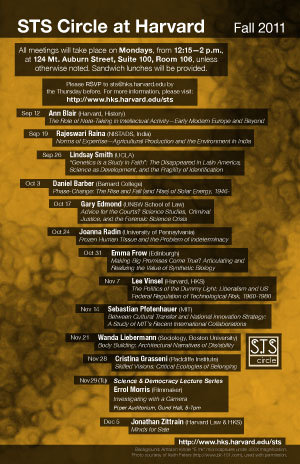 Fall 2011Sep. 12: Ann Blair (Harvard, History)
The Role of Note-Taking in Intellectual Activity—Early Modern Europe and Beyond Sep. 19: Rajeswari Raina (NISTADS, India)
Norms of Expertise—Agricultural Production and the Environment in India Sep. 26: Lindsay Smith (UCLA)
"Genetics is a Study in Faith": The Disappeared in Latin America, Science as Development, and the Fragility of Identification Oct. 3: Daniel Barber (Barnard College)
Phase-Change: The Rise and Fall (and Rise) of Solar Energy, 1946- Oct. 17: Gary Edmond (UNSW School of Law)
Advice for the Courts? Science Studies, Criminal Justice, and the Forensic Science Crisis Oct. 24: Joanna Radin (University of Pennsylvania)
Frozen Human Tissue and the Problem of Indeterminacy Oct. 31: Emma Frow (Edinburgh)
Making Big Promises Come True? Articulating and Realizing the Value of Synthetic Biology Nov. 7: Lee Vinsel (Harvard, HKS)
The Politics of the Dummy Light: Liberalism and US Federal Regulation of Technological Risk, 1960-1980 Nov. 14: Sebastian Pfotenhauer (MIT)
Between Cultural Transfer and National Innovation Strategy: A Study of MIT's Recent International Collaborations Nov. 21: Wanda Liebermann (Harvard, GSD)
Body Building: Architectural Narratives of Dis/ability Nov. 28: Cristina Grasseni (Radcliffe Institute)
Skilled Visions: Critical Ecologies of Belonging Dec. 5: Jonathan Zittrain (Harvard Law & HKS) Minds for Sale 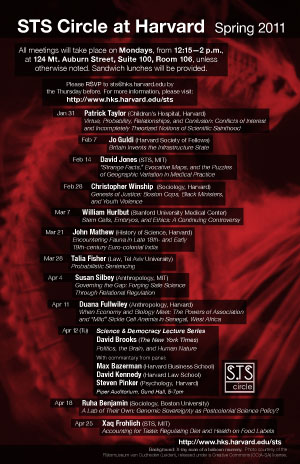 Spring 2011Jan. 31: Patrick Taylor (Children's Hospital, Harvard)
Virtue, Probability, Relationships, and Confusion: Conflicts of Interest and Incompletely Theorized Notions of Scientific Sainthood Feb. 7: Jo Guldi (Harvard Society of Fellows)
Britain Invents the Infrastructure State Feb. 14: David Jones (STS, MIT)
'Strange Facts,'Evocative Maps, and the Puzzles of Geographic Variation in Medical Practice Feb. 28: Christopher Winship (Sociology, Harvard)
Genesis of Justice: Boston Cops, Black Ministers, and Youth Violence Mar. 7: William Hurlbut (Stanford University Medical Center)
Stem Cells, Embryos, and Ethics: A Continuing Controversy Mar. 21: John Mathew (History of Science, Harvard)
Encountering Fauna in Late 18th- and Early 19th-century Euro-colonial India Mar. 28: Talia Fisher (Law, Tel Aviv University)
Probabilistic Sentencing Apr. 4: Ghislain Thibault (History of Science, Harvard)
Communicating Electricity: A Media Archaeology of Wireless Power Transmission Apr. 11: Duana Fullwiley (Anthropology, Harvard)
When State Economy and Population Biology Meet: The Powers of Association and 'Mild' Sickle Cell Anemia in Senegal, West Africa Apr. 18: Ruha Benjamin (Sociology, Boston University)
A Lab of Their Own: Genomic Sovereignty as Postcolonial Science Policy? Apr. 25: Xaq Frohlich (STS, MIT)
Accounting for Taste: Regulating Diet and Health on Food Labels May. 2: Eddie Haam (Applied Mathematics, Harvard) Pattern Recognition Algorithm for Climate Sciences 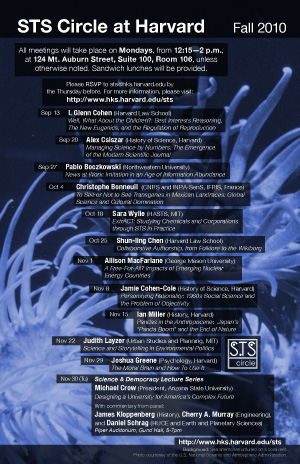 Fall 2010Sep. 13: I. Glenn Cohen (Harvard Law School)
Well, What About the Children?: Best Interests Reasoning, The New Eugenics, and the Regulation of Reproduction Sep. 20: Alex Csiszar (History of Science, Harvard)
Managing Science by Numbers: The Emergence of the Modern Scientific Journal Sep. 27: Pablo Boczkowski (Northwestern University)
News at Work: Imitation in an Age of Information Abundance Oct. 4: Christophe Bonneuil (CNRS and INRA-SenS, IFRIS, France)
To See or Not to See Transgenes in Mexican Landraces: Global Science and Cultural Domination Oct. 18: Sara Wylie (HASTS, MIT)
ExtrACT: Studying Chemicals and Corporations through STS in Practice Oct. 25: Shun-ling Chen (Harvard Law School)
Collaborative Authorship, from Folklore to the Wikiborg Nov. 1: Allison MacFarlane (George Mason University)
A Free-For-All? Impacts of Emerging Nuclear Energy Countries Nov. 8: Jamie Cohen-Cole (History of Science, Harvard)
Personifying Rationality: 1960s Social Science and the Problem of Objectivity Nov. 15: Ian Miller (History, Harvard)
Nov. 22: Judith Layzer (Urban Studies and Planning, MIT)
Science and Storytelling in Environmental Politics Nov. 29: Joshua Greene (Psychology, Harvard) The Moral Brain and How To Use It 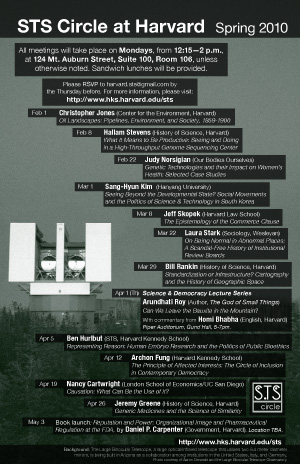 Spring 2010Feb. 1: Christopher Jones (Center for the Environment, Harvard)
Oil Landscapes: Pipelines, Environment, and Society, 1859-1900 Feb. 8: Hallam Stevens (History of Science, Harvard)
What It Means to Be Productive: Seeing and Doing in a High-Throughput Genome Sequencing Center Feb. 22: Judy Norsigian (Our Bodies Ourselves)
Genetic Technologies and their Impact on Women's Health: Selected Case Studies Mar. 1: Sang-Hyun Kim (Hanyang University)
Seeing Beyond the Developmental State? Social Movements and the Politics of Science & Technology in South Korea Mar. 8: Jeff Skopek (Harvard Law School)
The Epistemology of the Commerce Clause Mar. 22: Laura Stark (Sociology, Wesleyan)
On Being Normal in Abnormal Places: A Scandal-Free History of Institutional Review Boards Mar. 29: Bill Rankin (History of Science, Harvard)
Standardization or Infrastructure? Cartography and the History of Geographic Space Apr. 5: Ben Hurlbut (STS, Harvard Kennedy School)
Representing Reason: Human Embryo Research and the Politics of Public Bioethics Apr. 12: Archon Fung (Harvard Kennedy School)
The Principle of Affected Interests: The Circle of Inclusion in Contemporary Democracy Apr. 26: Jeremy Greene (History of Science, Harvard)
Generic Medicines and the Science of Similarity May. 3: Evelyn Fox Keller (STS, MIT)
Climategate, Science and Democracy May. 3: Daniel P. Carpenter (Government, Harvard) Book launch and panel: Reputation and Power: Organizational Image and Pharmaceutical Regulation at the FDA 4pm-6pm, Tsai Auditorium; see full program for details 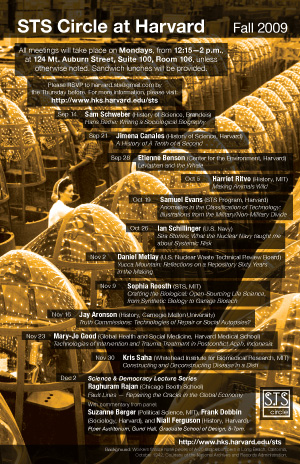 Fall 2009Sep. 14: Sam Schweber (History of Science, Brandeis)
Hans Bethe: Writing a Sociological Biography Sep. 21: Jimena Canales (History of Science, Harvard)
A History of A Tenth of a Second Sep. 29: Etienne Benson (Center for the Environment, Harvard)
Leviathan and the Whale Oct. 5: Harriet Ritvo (History, MIT)
Making Animals Wild Oct. 19: Samuel Evans (STS Program, Harvard)
Anomalies in the Classification of Technology: Illustrations from the Military/Non-Military Divide Oct. 26: Ian Schillinger (U.S. Navy)
Sea Stories: What the Nuclear Navy taught me about Systemic Risk Nov. 2: Daniel Metlay (U.S. Nuclear Waste Technical Review Board)
Yucca Mountain: Reflections on a Repository Sixty Years in the Making Nov. 9: Sophia Roosth (STS, MIT)
Crafting the Biological: Open-Sourcing Life Science, from Synthetic Biology to Garage Biotech Nov. 16: Jay Aronson (History, Carnegie Mellon University)
Truth Commissions: Technologies of Repair or Social Autopsies? Nov. 23: Mary-Jo Good (Global Health and Social Medicine, Harvard Medical School)
Technologies of Intervention and Trauma Treatment in Postconflict Aceh, Indonesia Nov. 30: Kris Saha (Whitehead Institute for Biomedical Research, MIT) Constructing and Deconstructing Disease in a Dish 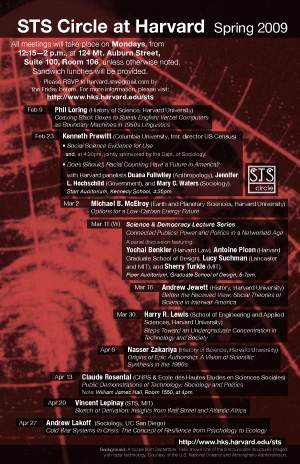 Spring 2009Feb. 9: Phil Loring (Harvard University)
Coaxing Black Boxes to Speak English: Verbal Computers as Boundary Machines in 1950s Linguistics Mar. 2: Michael B. McElroy (Harvard University)
Options for a Low-Carbon Energy Future Mar. 16: Andrew Jewett (Harvard University)
Before the Received View: Social Theories of Science in Interwar America Mar. 30: Harry R. Lewis (Harvard University)
Steps Toward an Undergraduate Concentration in Technology and Society Apr. 6: Nasser Zakariya (Harvard University)
Origins of Epic Authorship: A Vision of Scientific Synthesis in the 1990s Apr. 13: Claude Rosental (CNRS & Ecole des Hautes Etudes en Sciences Sociales)
Public Demonstrations of Technology: Sociology and Politics Apr. 20: Vincent Lepinay (MIT)
Sketch of Derivation: Insights from Wall Street and Atlantic Africa Apr. 27: Andrew Lakoff (UCSD) Cold War Systems in Crisis: The Concept of Resilience from Psychology to Ecology 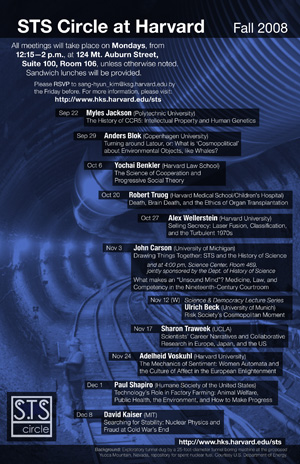 Fall 2008Sep. 22: Myles Jackson (Polytechnic University)
The History of CCR5: Intellectual Property and Human Genetics Sep. 29: Anders Blok (Copenhagen University)
Oct. 6: Yochai Benkler (Harvard Law School)
The Science of Cooperation and Progressive Social Theory Oct. 20: Robert Truog (Harvard Medical School/Children's Hospital)
Death, Brain Death, and the Ethics of Organ Transplantation Oct. 27: Alex Wellerstein (Harvard University)
Selling Secrecy: Laser Fusion, Classification, and the Turbulent 1970s Nov. 3: John Carson (University of Michigan)
Drawing Things Together: STS and the History of Science and at 4:00 pm, Science Center, Room 469, jointly sponsored by the Dept. of History of Science What makes an "Unsound Mind"? Medicine, Law, and Competency in the Nineteenth-Century Courtroom Nov. 17: Sharon Traweek (UCLA)
Scientists' Career Narratives and Collaborative Research in Europe, Japan, and the US Nov. 24: Adelheid Voskuhl (Harvard University)
The Mechanics of Sentiment: Women Automata and the Culture of Affect in the European Enlightenment Dec. 1: Paul Shapiro (Humane Society of the United States)
Technology's Role in Factory Farming: Animal Welfare, Public Health, the Environment, and How to Make Progress Dec. 8: David Kaiser (MIT) Searching for Stability: Nuclear Physics and Fraud at Cold War's End 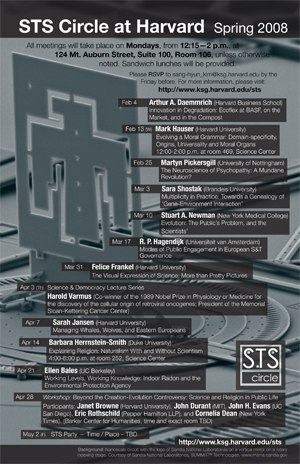 Spring 2008Feb. 4: Arthur A. Daemmrich (Harvard Business School)
Innovation in Degradation: Ecoflex at BASF, on the Market, and in the Compost Feb. 13: Mark Hauser (Department of Psychology, Harvard University)
Evolving a Moral Grammar: Domain-specificity, Origins, Universality and Moral Organs Feb. 25: Martyn Pickersgill (Institute for Science and Society, University of Nottingham)
The Neuroscience of Psychopathy: A Mundane Revolution? Mar. 3: Sara Shostak (Department of Sociology, Brandeis University)
Multiplicity in Practice: Towards a Genealogy of 'Gene-Environment Interaction' Mar. 10: Stuart A. Newman (Department of Cell Biology & Anatomy, New York Medical College)
Evolution: the Public's Problem, and the Scientists' Mar. 17: R. P. Hagendijk (International School for Humanities and Social Sciences, Universiteit van Amsterdam)
Modes of Public Engagement in European S&T Governance Mar. 31: Felice Frankel (Envisioning Science Program, Initiative in Innovative Computing, Harvard University)
The Visual Expression of Science: More than Pretty Pictures Apr. 7: Sarah Jansen (Department of the History of Science, Harvard University)
Managing Whales, Wolves, and Eastern Europeans Apr. 14: Barbara Herrnstein-Smith (Department of English, Duke University)
Explaining Religion: Naturalism With and Without Scientism Apr. 21: Ellen Bales (History of Science and Technology, UC Berkeley) Working Levels, Working Knowledge: Indoor Radon and the Environmental Protection Agency Fall 2007Oct. 9: Ulrike Felt (Department of Social Studies of Science, University of Vienna, Austria)
Biomedical Technologies, Citizens and Their Epistemologies: Comparative Analysis of Knowledge Narratives in Public Assessment of Biomedical Technologies Oct. 15: Allan Brandt (Department of the History of Science, Harvard University)
Science, Risk, and Regulation: Lessons from the Tobacco Pandemic Oct. 22: Justus Lentsch (Institute for Science and Technology Studies, Bielefeld University, Germany)
Scientific Advice to Policymaking: Relation between Organizational Form and Function Oct. 29: Chris Kelty (Department of Anthropology, Rice University; and Department of the History of Science, Harvard University)
Imagining Neutrality: Recursive Publics, Free Software and Electronic Voting Machines Nov. 5: Philip Campbell (Editor-in-Chief, Nature)
Gaps in the Sciences of Human Enhancement Nov. 19: Les Boden and David Ozonoff (Department of Environmental Health, Boston University School of Public Health; and Project on Scientific Knowledge and Public Policy)
SKAPP: Scientists Look at Science and the Law Nov. 26: Daniel Sarewitz (Consortium for Science, Policy and Outcomes, Arizona State University)
New Tools for Science Policy Making Dec. 3: Claire Donovan (Research School of Social Sciences, Australian National University)
The Governance of Social Science: The Social Science that Dare Not Speak Its Name Dec. 10: Stefan Helmreich (Anthropology Program, MIT) How the Ocean Got Its Genome: Bodies of Knowledge and Bodies of Water in Marine Microbiology Spring 2007Feb. 5: Rebecca Herzig (Women and Gender Studies, Bates College)
Feb. 12: Reading Galison / Minow: "Our Privacy, Ourselves in the Age of Technological Intrusions" Feb. 26: Martha Minow (Harvard Law School)
Mar. 5: Reading Graeber: "Revolution in Reverse" Mar. 12: David Graeber (Anthropology, Yale University)
Mar. 19: Richard Levins (Harvard School of Public Health)
Apr. 2: Kathryn Packer (Dept. for Environment, Food, and Rural Affairs, UK)
Apr. 9: Yaron Ezrahi (Political Science, Hebrew University, Jerusalem)
Apr. 16: Peter Galison (History of Science, Harvard)
Apr. 23: Arun Agrawal (Natural Resources & Environment, University of Michigan)
Apr. 30: Joan Fujimura (Sociology, University of Wisconsin-Madison) Fall 2006Sep. 16: Discussion: STS among the Disciplines Oct. 12: Discussion of Readings by Michael Fischer Oct. 16: Michael Fischer (Professor of Anthropology and STS, MIT)
Nov. 6: Fieldwork and Ethics in Genetics and Society Discussion led by Sarah Wagner (Anthropology, Harvard), Lindsay Smith (Anthropology, Harvard), and Xaq Frohlich (STS, MIT) Nov. 13: Diane Paul (Harvard University Program in Ethics and Health/UMass Boston)
Nov. 20: Barbara Costa (Museum of Science, Boston)
Nov. 27: Discussion of Readings by Michele Lamont Dec. 4: Michele Lamont (Professor of Sociology, Harvard University)
Dec. 11: Brock Reeve (Executive Director, Harvard Stem Cell Institute) |
||||||
