Program on Science, Technology and Society at HarvardHarvard Kennedy School of Government | Harvard University |
|||||||
|
|
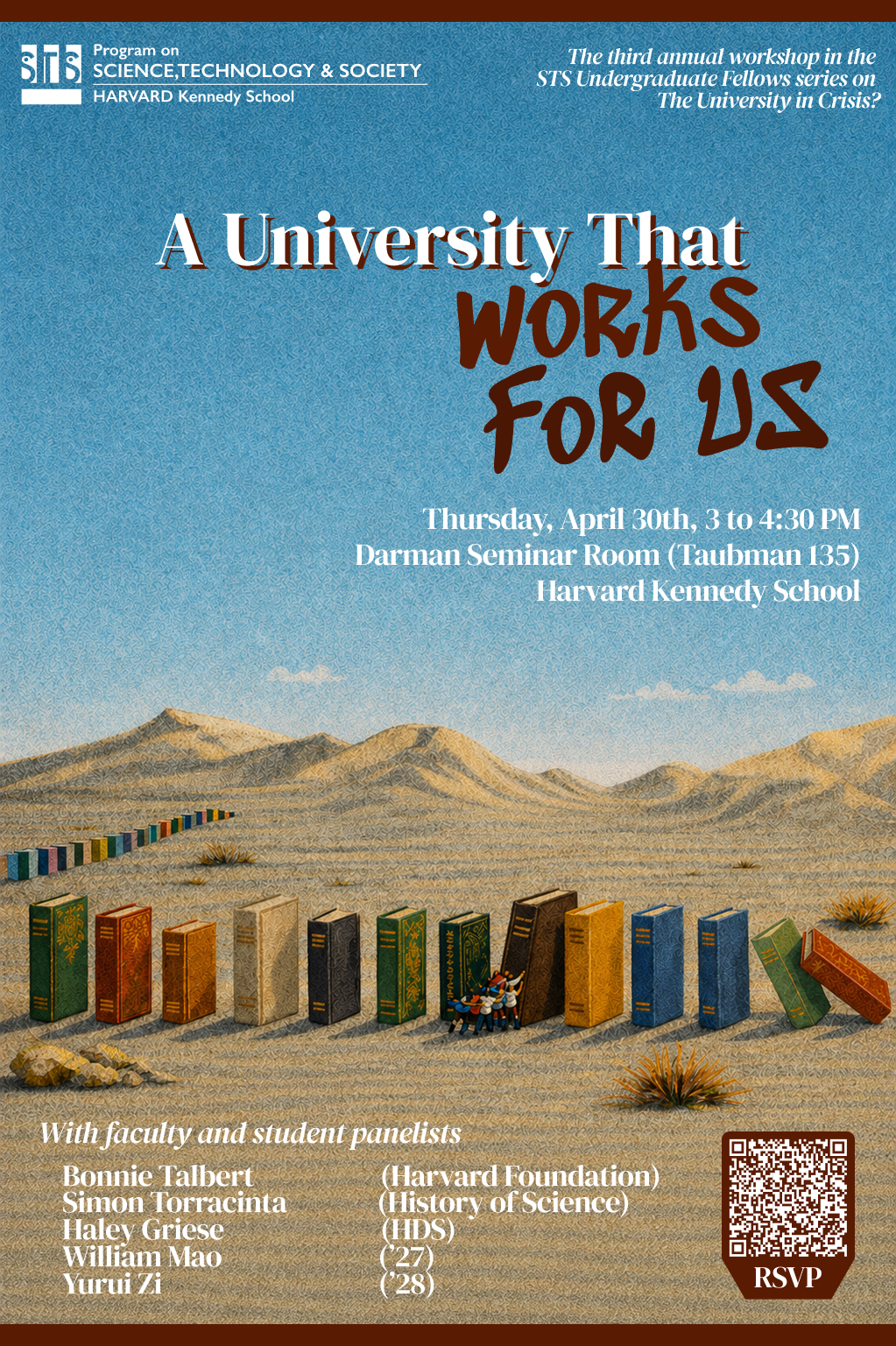 A University That Works For Us: Teaching and Learning in Uncertain TimesApril 30, 2026, 3:00pm-4:30pm AbstractAs Harvard undergraduates, we face novel challenges. Threats to federal funding for research and graduate training, a precarious and shrinking labor market for college-educated workers and for academic jobs, and new technologies that imitate and diminish human creativity have brought acute turmoil to the core of our intellectual life. There is a growing sense that Harvard, and universities more broadly, must “modernize” to keep pace with these changes. But how do we know what the right modern education would comprise? Our workshop seeks to put diverse perspectives on the future of the university in conversation through exploring the “work” required to make a university “work”: specifically, academic labor and capital. Debates about the meaning and value of teaching and learning have increasingly been driven by campus labor movements, which are raising new concerns about pressures to incorporate AI into the classroom. At the same time, private capital is ever more deeply invested in the university, exerting influence not only through major donations but also through pre-professional student organizations, the promotion of startup culture on college campuses, and fellowships aimed at supplanting a college education altogether. Still other reactions to the changing university have sought to recover the humanistic dimensions of a liberal arts education. As the traditional structures and supports for academic life grow more precarious, and as alternative visions of intellectual formation proliferate, it is time to articulate an affirmative vision of what the university is for — and the forms of work required to realize it. This will be the third discussion hosted by the Undergraduate Fellows of the Program on Science, Technology, and Society, following well-received panels on truth and reason in 2024 and AI and education in 2025. A key feature of our workshops has been to gather students, faculty, and staff in conversation, and this year will follow in that tradition. We hope the event will create a space for critical reflection on ongoing changes to the university, how they are experienced across our institution, and what it might mean to resist the framing of such transformations as inevitable. Register here. |
||||||