Program on Science, Technology and Society at HarvardHarvard Kennedy School of Government | Harvard University |
|||||||
|
|
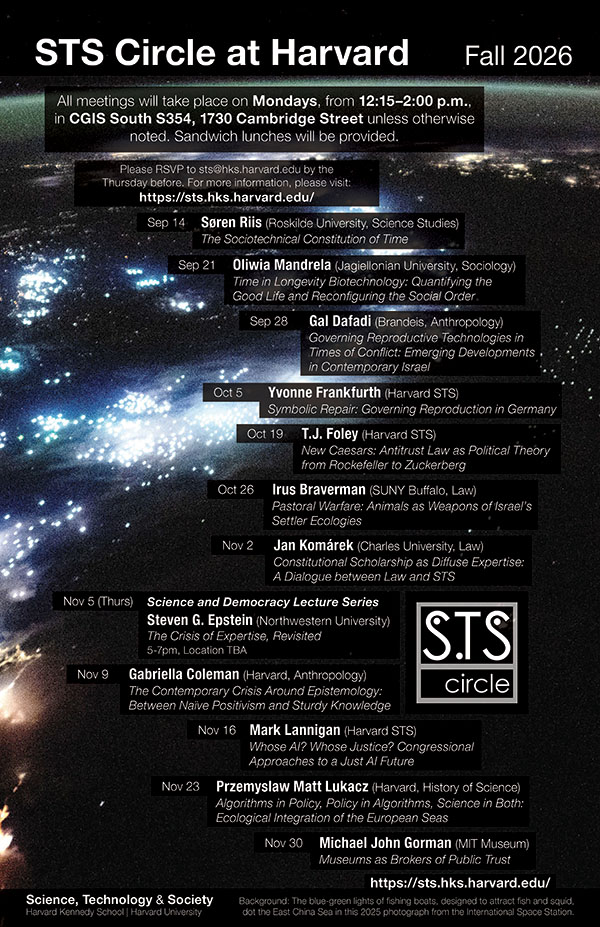
EventsSTS CircleThe STS Circle at Harvard meets weekly during the academic semester. For Fall 2025, all meetings are planned to take place in person on Mondays, from 12:15-2:00 p.m., in CGIS South S354, 1730 Cambridge Street unless otherwise noted. Sandwich lunches will be provided. To receive the abstract and bio for each talk, and to register to attend, please join our mailing list. Fall 2026Sep. 14: Søren Riis (Roskilde University, Science Studies)
The Sociotechnical Constitution of Time Sep. 21: Oliwia Mandrela (Jagiellonian University, Sociology)
Time in Longevity Biotechnology: Quantifying the Good Life and Reconfiguring the Social Order Sep. 28: Gal Dafadi (Brandeis, Anthropology)
Governing Reproductive Technologies in Times of Conflict: Emerging Developments in Contemporary Israel Oct. 5: Yvonne Frankfurth (Harvard STS)
Symbolic Repair: Governing Reproduction in Germany Oct. 19: T.J. Foley (Harvard STS)
New Caesars: Antitrust Law as Political Theory from Rockefeller to Zuckerberg Oct. 26: Irus Braverman (SUNY Buffalo, Law)
Pastoral Warfare: Animals as Weapons of Israel's Settler Ecologies Nov. 2: Jan Komárek (Charles University, Law)
Constitutional Scholarship as Diffuse Expertise: A Dialogue between Law and STS Nov. 9: Gabriella Coleman (Harvard, Anthropology)
The Contemporary Crisis Around Epistemology: Between Naïve Positivism and Sturdy Knowledge Nov. 16: Mark Lannigan (Harvard STS)
Whose AI? Whose Justice? Congressional Approaches to a Just AI Future Nov. 23: Przemyslaw Matt Lukacz (Harvard, History of Science)
Algorithms in Policy, Policy in Algorithms, Science in Both: Ecological Integration of the European Seas Nov. 30: Michael John Gorman (MIT Museum) Museums as Brokers of Public Trust » More information and past schedules Science & Democracy Lecture SeriesOnce a semester, the STS Program, with co-sponsorship from other local institutions, hosts an installation in its Science and Democracy Lecture Series.
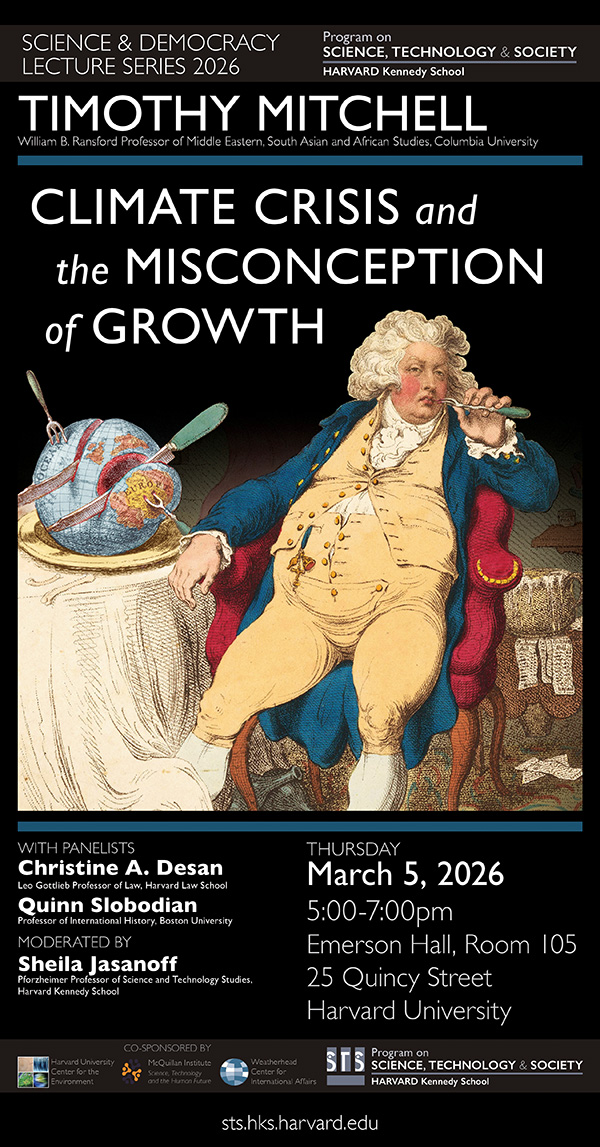
In the face of climate catastrophe, why have existing conceptions of collective life appeared so impervious to critique? One concept stands out: the idea of the economy and our preoccupation with its continued growth. For most people, including its critics, economic growth appears as the inevitable movement of capitalist society, driven by a process of technological improvement or an endless accumulation of capital. It is almost never connected to capitalization, or the capitalist modes of indebting and extracting payment from the future. Growth is better understood as a device for securing the repayment of debt. This does not make it any less damaging to collective well-being. But it does allow growth to be grasped not as the inevitable movement of capitalist development but as a more recent arrangement that arises from—rather than simply causing—a mode of living at the expense of the future. Co-sponsored by Harvard University Weatherhead Center for International Affairs, Harvard University Center for the Environment (A Center of the Salata Institute), and the McQuillan Institute. Workshops and Panels
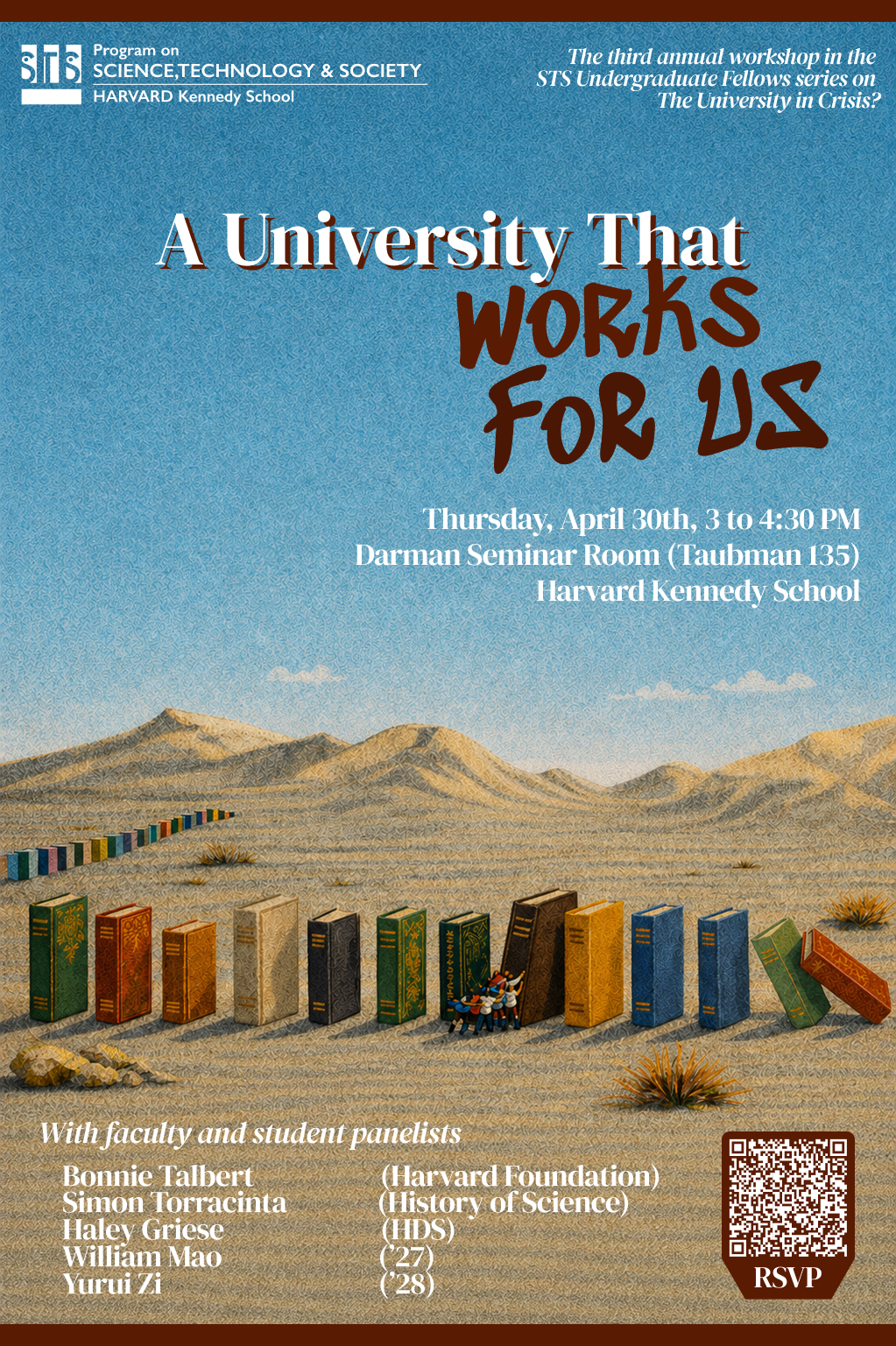
As Harvard undergraduates, we face novel challenges. Threats to federal funding for research and graduate training, a precarious and shrinking labor market for college-educated workers and for academic jobs, and new technologies that imitate and diminish human creativity have brought acute turmoil to the core of our intellectual life. There is a growing sense that Harvard, and universities more broadly, must “modernize” to keep pace with these changes. But how do we know what the right modern education would comprise? Our workshop seeks to put diverse perspectives on the future of the university in conversation through exploring the “work” required to make a university “work”: specifically, academic labor and capital. Debates about the meaning and value of teaching and learning have increasingly been driven by campus labor movements, which are raising new concerns about pressures to incorporate AI into the classroom. At the same time, private capital is ever more deeply invested in the university, exerting influence not only through major donations but also through pre-professional student organizations, the promotion of startup culture on college campuses, and fellowships aimed at supplanting a college education altogether. Still other reactions to the changing university have sought to recover the humanistic dimensions of a liberal arts education. As the traditional structures and supports for academic life grow more precarious, and as alternative visions of intellectual formation proliferate, it is time to articulate an affirmative vision of what the university is for — and the forms of work required to realize it. This will be the third discussion hosted by the Undergraduate Fellows of the Program on Science, Technology, and Society, following well-received panels on truth and reason in 2024 and AI and education in 2025. A key feature of our workshops has been to gather students, faculty, and staff in conversation, and this year will follow in that tradition. We hope the event will create a space for critical reflection on ongoing changes to the university, how they are experienced across our institution, and what it might mean to resist the framing of such transformations as inevitable. » Workshops and panels archive Program newsSubmit your abstract to present at 7th annual Graduate Research in STS (GRiSTS) Conference (due Friday, September 11). The first STS Circle for the Fall 2026 semester will be held on Monday, September 14. Apply here to join the 2026-2027 STS Undergraduate Fellowship! (Deadline: June 28) STS Fellow Pariroo Rattan recently defended her dissertation, "A Marketplace for Populism: The Moral Politics of Digitization in India's Informal Economy," joining Nicole and Hilton to complete our trio of outstanding newly minted doctors. Congratulations to our extraordinary STS Fellows Nicole West Bassoff and Hilton Simmet, the first graduates to hold a PhD in Public Policy on the Science, Technology and Policy Studies track! Nicole's dissertation is titled "Can Cities Be Smart? Urban Governance in the Digital Age," and Hilton's is "Just Economics: Inequality and Political Culture in Cross-National Perspective." Two STS Undergraduate Fellows received a Hoopes Prize for their senior theses — Katie Burstein with “The Body Restored: Constructions of the Patient in the Cult of Asclepius,” and Emil Massad with “We Never Said You Weren’t Exposed: Risk in the Aftermath of the Train Derailment in East Palestine, Ohio.” Join us for the Global Observatory for Genome Editing International Summit on May 21-23. Register and learn more here. Register here for a panel discussion on April 24 regarding recent changes to federal research funding, co-hosted with the Harvard Griffin GSAS Science Policy Group. The 2025 STS Undergraduate Essay Prize contest is now open. Submissions are due here by April 14, 2025. The 2025-2026 STS Fellows application is now OPEN. Application deadline has been extended to March 14, 2025. |
||||||