Program on Science, Technology and Society at HarvardHarvard Kennedy School of Government | Harvard University |
|||||||
|
|
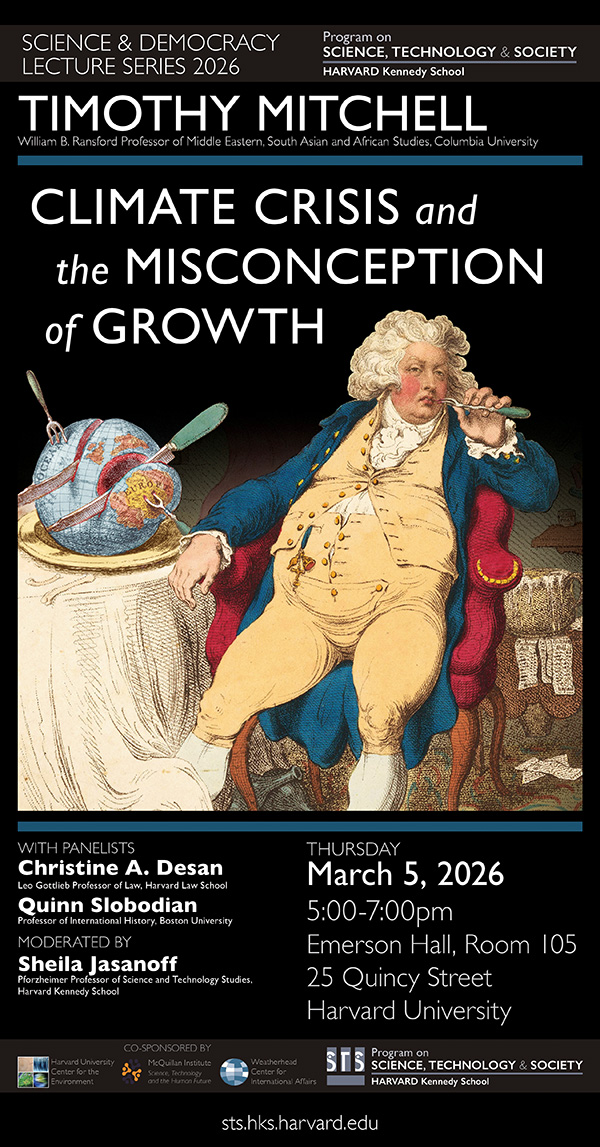
Climate Crisis and the Misconception of GrowthTimothy MitchellWilliam B. Ransford Professor of Middle Eastern, South Asian and African Studies, Columbia University March 5, 2026, 5:00pm-7:00pm AbstractIn the face of climate catastrophe, why have existing conceptions of collective life appeared so impervious to critique? One concept stands out: the idea of the economy and our preoccupation with its continued growth. For most people, including its critics, economic growth appears as the inevitable movement of capitalist society, driven by a process of technological improvement or an endless accumulation of capital. It is almost never connected to capitalization, or the capitalist modes of indebting and extracting payment from the future. Growth is better understood as a device for securing the repayment of debt. This does not make it any less damaging to collective well-being. But it does allow growth to be grasped not as the inevitable movement of capitalist development but as a more recent arrangement that arises from—rather than simply causing—a mode of living at the expense of the future. PanelChristine A. DesanLeo Gottlieb Professor of Law, Harvard Law School Quinn SlobodianProfessor of International History, Boston University Moderated bySheila JasanoffPforzheimer Professor of Science and Technology Studies, Harvard Kennedy School About the speakerTimothy Mitchell is the William B. Ransford Professor of Middle Eastern Studies at Columbia University, where he served as chair of the MESAAS Department from 2011 to 2017. Educated at Cambridge University and Princeton University in the fields of law, history, and politics, he works across the disciplinary boundaries of history and the social sciences. His writings, which have been translated into Arabic and fifteen other languages, examine the history of colonialism, the politics of energy, the political economy of capitalism, and the making of expert knowledge. His books include Colonising Egypt, Rule of Experts, and Carbon Democracy. A new book, The Alibi of Capital: How We Broke the Earth to Steal the Future on the Promise of a Better Tomorrow, is being published in March 2026. Co-sponsored by Harvard University Weatherhead Center for International Affairs, Harvard University Center for the Environment (A Center of the Salata Institute), and the McQuillan Institute. Register for the in-person event here. Poster art by Alex Wellerstein, combining James Gillray’s “A Voluptuary under the Horrors of Digestion” (1792) and “The Plumb-pudding in Danger” (1805). |
||||||